The Still Small Voice
Somebody will sit in a room you designed on the worst day of their life. You will not be there. You will never know it happened. Nothing about that requires you to care, which is precisely why the caring is the whole job

Somewhere in St. Louis there is a mid-century Baptist church that is no longer a Baptist church, and is also not gone.
We do not usually get to have it both ways. A building is either standing or it is rubble. A congregation either keeps its home or sells it. Two communities either stay two communities or one of them absorbs the other and calls it a merger.
The Hanley Road Baptist Church is still there. It is inside a synagogue now. Kol Rinah folded it into a new social hall rather than knocking it down, and in 2026 the project won a Faith and Form International Award for Religious Architecture in the renovation category. Patterhn Ives designed it. Kirkegaard handled acoustics. Alper Audi engineered the structure. TEN x TEN shaped the landscape. Sam Fentress photographed the result.
I want to talk about why the easy thing would have been a wrecking ball, and why they did not reach for one.
Memory is not sentimentality
The jury said the project is "about the possibilities and promise of finding common ground." They meant it in two directions at once: two Jewish congregations becoming one, and a preexisting church becoming part of a new addition. They also said this: the easiest option would have been to demolish the church.
They are right. Demolition is always the easiest option. It is fast, it is legible on a budget line, and it leaves you a clean site with no arguments in it. Every hard decision a building can force on you disappears the moment the building does.
So people demolish. Not because the analysis said to. Because the analysis was expensive and the bulldozer was cheap.
The pattern is not confined to architecture. Southwest Airlines spent fifty-four years telling people their bags flew free, and then in 2025 the promise stopped fitting the revenue model, so the revenue model erased it. They kept the planes and the paint and threw away the reason anyone loved them.
They call it a fresh start. It is usually just avoidance wearing a nicer suit.
Kol Rinah kept the church. They gave it a purpose, and they let it stay legible as itself inside a building that has a different faith and a different name and a different future. The old sanctuary became the place the community gathers.
That is not nostalgia. Nostalgia keeps the object and forgets the reason. This kept the reason.
Three functions, one roof
The program is simple to say and brutally hard to build. Gathering. Learning. Prayer.
Those three things want different rooms. Gathering wants noise, movement, food, kids running between adult legs. Learning wants focus and a certain kind of alertness. Prayer wants something else entirely, something most modern buildings have no idea how to produce.
Most institutions solve this by picking one and letting the other two live in compromised leftovers. The gym doubles as the auditorium. The lobby doubles as the classroom. Everyone agrees it is fine. Nobody is served.
All spaces are sacred. I mean that literally. A space is sacred not because of what it was built for but because of what it makes possible. A parking garage can heal a person. Your mother's kitchen can do it too. The potential is always there. What kills it is not budget or style. It is indifference. A room that was never asked what it owed the people inside it.
The multipurpose room is indifference with a floor plan. It answers no question fully because it was never made to answer one. It processes people instead of receiving them. And everyone who walks through it feels that, in the body, before the mind gets a vote.
Kol Rinah gave each function its own logic and then made them share a home. The former church carries the gathering. The new sanctuary carries the prayer. And the whole thing sits on the edge of a growing business district, which is to say it sits in a place that does not care what happens inside it. The city presses right up against the walls.
That constraint is the design. Not the obstacle to the design.
The threshold does the work
From the street, the new sanctuary is austere. Heavy stone. Protective. It does not perform for traffic. It does not invite you in with glass and good intentions, and given the safety concerns any synagogue in this decade has to plan for, that restraint is not aesthetic preference. It is care, expressed in mass.
Then you cross the threshold, and the building takes you in. That is the right word for it. Not admits. Not permits. Takes you in, the way a house does when someone who belongs there comes home.
The entry and lobby are filled with natural light by day. At night they glow from within. The heavy shell opens into a double-height worship space that is unexpectedly light-filled, and the jury noticed that the site planning solved the safety problem without sacrificing that light. That is the hard version of the problem. Anyone can make a bunker. Anyone can make a greenhouse. Making a building that is a fortress to the street and a lantern to the congregant is the whole job.
The first ninety seconds of an experience decide the next ninety minutes. Arrival is not a formality. Arrival is where a person decides, below the level of conscious thought, whether they are safe here and whether they belong here. Everything after that is either riding that decision or fighting it.
For a room where two congregations are learning to be one congregation, that decision matters more than usual. Nobody walks into a merger without an inventory of what they gave up. The building cannot argue them out of it. What the building can do is make the crossing feel like an arrival rather than a surrender.
A luminous threshold does that without saying a word.
The quiet that prayer actually needs
People get quiet wrong.
They think it is an absence. Remove the noise, remove the echo, kill the reflections, and what remains is peace. So they build spaces that are acoustically dead, and then they cannot understand why the room feels like a held breath. Why nobody wants to speak in it. Why a hundred people singing sound like a hundred people singing alone.
Dead quiet is not tranquil. Dead quiet is anxious. A room with no life in it makes every human sound feel like an intrusion.
What prayer needs is a grounded quiet. A room that is calm but not empty. A room that holds a voice, gives it a little back, and lets a congregation hear itself as one body rather than as a crowd of individuals who happen to be in the same building. You should be able to whisper and be believed. You should be able to sing and be joined.
Getting that is not luck. Kirkegaard was in that room, on that project, for a reason, and their brief says exactly what I am describing: the room had to carry the spoken word clearly, and it had to stay alive enough underneath a congregation that was singing. Both, at once, in the same stone. Material, light, and sound were composed together, not sequenced, not layered on at the end after the pretty parts were locked.
And when it is done right, nobody in the congregation will ever notice it. They will not walk out saying the reverberation time was well judged. They will say the room felt peaceful. They will say they could hear themselves again.
Some of them will say they heard something else.
Elijah stood on the mountain while a great wind tore it apart, and God was not in the wind. Then the earthquake, and God was not in the earthquake. Then the fire, and God was not in the fire. After the fire came a still small voice.
That is what a sanctuary is for. Not to amplify anything. To quiet everything else down far enough that a voice with no volume at all can be heard.
The reverse is also true. A badly built room drowns God out.
Not metaphorically. The wind and the earthquake and the fire were real, and so is the low hum of an air handler you never consciously notice, and so is an echo bouncing off a hard back wall a half second after every word, and so is a room so dead that a man becomes aware of his own breathing and cannot stop hearing it. None of that registers as noise. It registers as a feeling that something here is slightly wrong. And it stands exactly where the voice was supposed to be.
That is the stake. Not comfort. Not whether the cantor sounds good on a Tuesday. Whether the room lets the still small voice reach the person who drove across town to hear it.
The building is making an argument
We talk about buildings as containers. Put the people in, and whatever they do inside is up to them.
That is false. A room is not neutral. A room has a position. It is telling you, constantly, what kind of person you are supposed to be in it and what kind of thing is supposed to happen here. The only question is intention. Every room is saying something. The difference is whether anyone meant it.
Kol Rinah decided.
The stone says: you are protected here, and we took that seriously enough to build it out of something heavy.
The light says: protection is not the same as fear, and we will not trade your joy for your safety.
The old church, still standing inside the new hall, says: memory is not a threat to identity. We can be who we are and still honor what was here first.
And the two congregations, now one, walking through a threshold that was built to make the crossing feel like a welcome, are being told something too. That common ground is not what you settle for when neither side wins. It is what you build, deliberately, at cost, because the alternative is a clean site with nothing on it.
Someone had to choose all of that. Someone sat in a room and decided how heavy the stone would be, and where the light would fall, and how long a word would hang in the air before it let go. None of it happened on its own.
That choosing is the whole job. Not the styling. Not the budget. The choosing.
Most of the rooms in the world were built by people who never knew they were being asked. Not careless people. Unaware ones. Nobody told them the room would be making an argument whether they wrote one or not, so the room made one anyway, and it said whatever the cheapest available material happened to say. You cannot be careful with something you do not know you are holding.
But now you know.
Every space is sacred, not because of what it was built for, but because of what it makes possible. And what a space makes possible is not a matter of taste. It is a matter of what a person will be able to feel, and think, and hear, in the hours they spend inside something you made.
We are not decorating rooms. We are deciding what a person will be able to hear in them.
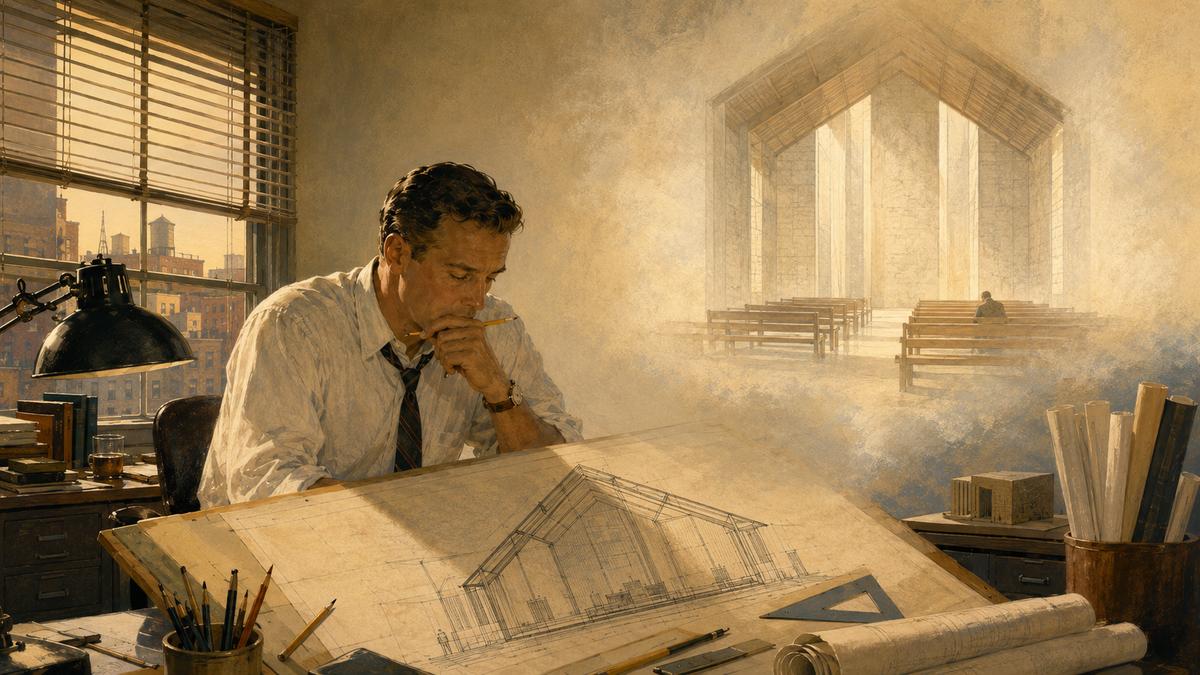
And we do it from a distance. That is the part worth understanding. A designer sits in an office, drawing a room he has never stood in, for people he will never meet, and in all likelihood he will never once set foot in the finished thing. He will not be there on the morning a widow comes in early because the house is too quiet. He will not be there when a man who has not prayed in twenty years sits down in the back row and finds, to his own surprise, that he can hear himself think.
Nothing about that designer's situation requires him to care. No one is watching. No one will ever check. The drawing will be signed and the invoice will be paid whether he asked what the room owed the people inside it or never thought to ask at all.
Which is exactly why the asking is the mark of the craftsman. Care that is compelled is not craft. It is compliance. Craft is what a person does when nothing at all obligates him to do it well, and he does it well anyway, for a stranger, in a room he will never see.
Every room you build is a room someone will one day need. You will not be there. Build it as though you would be.