Ten Percent of What?
Someone offers you a slice of their someday company if you build the whole thing now. It sounds generous. The math tells another story, and so do two thousand years of people arguing about the price of work no one can see.

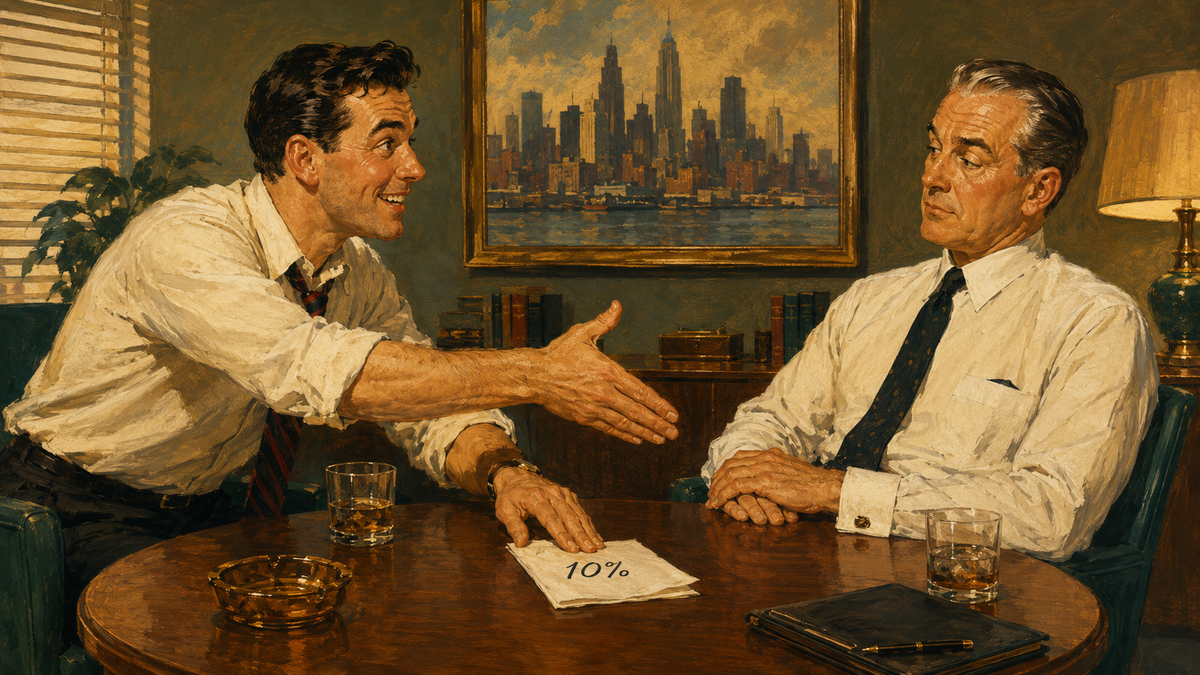
"I'll give you ten percent."
He said it the way people say things they believe are generous. Leaning in, warm, certain he was handing me a gift. And in his mind, he was. Ten percent of the company we were going to build. The company that was going to be big.
I have this conversation, or something close to it, dozens of times a year. The details move around. Sometimes it is ten percent, sometimes five, once it was "we'll sort out the equity later." The idea is always brilliant. The person is almost always sincere. And the ask underneath it never changes. Build the thing. Build all of it. The structure, the software, the systems, the unglamorous machinery nobody ever sees. Spend a year of your life turning my idea into something real. And when it works, you will own a slice.
So I asked the only question that matters.
"Ten percent of what?"
He blinked.
The math nobody wants to do
There was no company. Not yet. There was no product. There were no investors. The idea had never been placed in front of a single paying customer to find out whether anyone, anywhere, would trade money for it. What existed was a sentence, an enthusiasm, and a conviction that the hard part was already finished because the hard part, in his mind, was having the idea.
Ten percent of nothing is nothing.
That is not a jab. It is arithmetic. And it gets sharper the longer you look at it. Because his ten percent only becomes worth something after I show up and build the other ninety. The structure that lets the thing take money. The software that makes it work. The operations that keep it alive at two in the morning when it breaks. I would be manufacturing my own payment out of my own hours, and handing him the majority of it for the privilege. He would risk nothing. He would keep control of everything. And if it failed, he would walk away with a lesson, while I walked away with a year I could not get back.
The offer was not a partnership. It was a transfer. My labor, now, for his promise, later.
The new version of an old sentence
Lately the ask wears a new coat, and it is the reason so many people now feel entitled to make it.
"It's just AI now."
It's easy. It's fast. It shouldn't take that long, and it shouldn't cost that much, because the machine does the work. I hear this constantly. The belief that the tools have become so powerful that the labor has evaporated, that what used to take a team and a year now takes a weekend and a subscription.
But easy and simple are not the same word, and the gap between them is the whole misunderstanding. Easy means near at hand. Familiar. Low effort, right now. Simple means few moving parts. AI made the tools easy. It put real power within reach of anyone who wants it. It did not make the work simple, and it did not make the knowing easy. Those are three different things. The ask treats them as one.
And here is what I have learned to say back, gently, because it ends the conversation every time.
If it is that easy, why are you asking me?
The answer is always the same, even when they cannot say it out loud. They already tried. They sat down with the very tools everyone promised would make it effortless, and they found out. The idea that was going to build itself did not build itself. The ask is not a shortcut. It is a confession. It is the evidence that the easy thing was never easy.
Knowing where to tap
None of this is new. We have been arguing about the price of invisible work for a very long time.
In 1907, an English magazine ran a small story it called, plainly, a fable. A factory's best machinist had been let go. Soon after, the great machine at the end of the room stopped cold, and the whole floor went idle. Everyone who could tell a wrench from a turnip had a try at it. The machine sat there and laughed at them. So they swallowed their pride and called the old machinist back.
He looked at it for a while. He talked to it the way a man talks to a horse. Then he climbed inside, called for a hammer, and tapped. Tap, tap, tap. The wheels spun. The floor came back to life. And in time the owner received a bill for ten guineas, which struck him as a great deal of money for a few taps of a hammer, so he asked, politely, for it to be itemized. The second bill came back.
To tapping machine with hammer, ten shillings.
To knowing where to tap it, ten pounds.
That story has survived for more than a century, and it has been retold a hundred ways, because it answers the hardest question in any craft. The tapping was never the job. The knowing where to tap is the job. The hammer is nothing. The years that taught the hand where to place it are everything, and they are invisible, and invisible things are hard to put a price on.
Now hold that fable up against the machine everyone is talking about today.
AI did not change the work. It changed the hammer. It made a very fast, very impressive hammer, and it put one in everybody's hand. The tapping got quicker. That is real, and it is good. But the knowing where to tap did not move an inch. It is still inside a person who spent years learning it, because that knowledge was never in the tool. It was never in the hammer. The tool got better. The judgment got no easier to earn.
What actually happened is a trick of perception. The hammer became so visible and so slick that it looks like it does the work, which makes the expertise behind it look small, or optional, or free. But the reality underneath has not budged. Someone still has to know where to tap. That someone is still a person. That person still spent a life learning it.
What a life is worth by the hour
Here is where I stop talking about tools and start talking about people, because that is what this has always been about.
When you ask me to build your company for a promise, you are not asking for a favor. You are asking for a year. Real hours, taken from a finite supply, that I do not get back and cannot resell. That is the actual thing on the table. Not effort in the abstract. A measured piece of one human life.
Two traditions much older than any of us understood exactly what that means, and neither of them treated it as sentiment. They treated it as law.
The labourer is worthy of his hire.
That is Luke, and Paul repeats it, and it is not a soft suggestion to be nice. It is a statement about what is owed. Work has a wage attached to it the way a cause has an effect. To take the work and withhold the wage is not thrift. It is a debt left unpaid.
The Torah is more specific still. Do not hold a hired worker's wages overnight. Pay him the same day, before the sun sets, because he is poor and his life depends on it. And the Talmud, turning that verse over, arrives at a line that has stayed with me for years.
One who withholds the wages of a hired laborer, it is as though he takes his life from him.
Read that slowly. Not his money. His life. Because the worker spent his hours, his body, his day, the one thing that does not refill, and to keep his pay is to keep a piece of the life he already handed you.
That is the whole matter, stated two thousand years before anyone slid a napkin across a table and offered me ten percent of an idea. When you ask someone to pour a year into your dream and pay them in a promise, you are keeping a piece of their life. The tradition already had a word for that, and the word was never opportunity.
It cuts both ways
Now let me be fair. The people who ask this are rarely trying to get away with anything.
Pricing something you cannot hold in your hand is genuinely hard. It is hard for the person buying, and it is hard for the person selling, and it always has been. When you buy a table, you can see the wood. You can run your hand along the joint. The value is right there in front of you. When you buy judgment, experience, the knowing where to tap, there is nothing to run your hand along. The most valuable part is the part you cannot see. So the mind does what minds do with invisible things. It assumes they are small.
That is not always greed. Often it is just the perception gap, the same gap that made the factory owner squint at a ten guinea bill for a few taps of a hammer. He was not being cheap. He simply could not see the forty years standing behind the hammer.
And we who do the work own the other half of this. We are, most of us, terrible at naming our own value. We hide the years. We quote the tapping and stay silent about the knowing, and then we feel wronged when someone prices us by the only part we let them see. The genius of that old machinist was not the repair. It was the second invoice. He made the invisible visible. He itemized the knowing. That is the job too, and most of us never learn it.
The honest version of the ask
So I am not telling anyone to stop dreaming, or to stop building, or to stop asking for help. I am telling you what the honest version of the ask looks like.
Pay for the work. Not because I need to be told my worth, but because paying for it is how you say, out loud, that you understand what you are actually asking for.
Or, if there is truly no money yet, then offer something real instead of something imagined. Real equity in something funded, or tested, or already earning, where the risk is shared and not simply handed to the person with the skills. A fair split is one where we both have something to lose. The moment all the risk sits on one side of the table, it is not a partnership. It is a debt transfer wearing a partnership's clothes.
And to the craftsman reading this, the one who has given away too many years already: name your value. Write the second invoice. Do not give the year away because you were too proud, or too grateful, or too afraid to say what the knowing costs.
The part that matters
The people who make this ask are, mostly, sincere. That is the part I keep coming back to. They have simply never been shown what they are asking for, because the most valuable work in the world is the work you cannot see, and no one ever taught them how to see it.
So show them. Kindly, plainly, without heat. Turn the light on. Tell them what a year is. Tell them where the value actually lives.
Because everything I believe about business starts in the same place, and it is not a strategy. It is a posture. People first, always. And you cannot put people first while you are asking them to hand you a piece of their life for a promise you have not earned the right to make.
Work has value. Until you can see it in someone else's work, people first is only a slogan.