The Inverted T
The world keeps two words in separate rooms and calls you one or the other, never both. It has the geometry exactly upside down, and a machine is about to prove it.

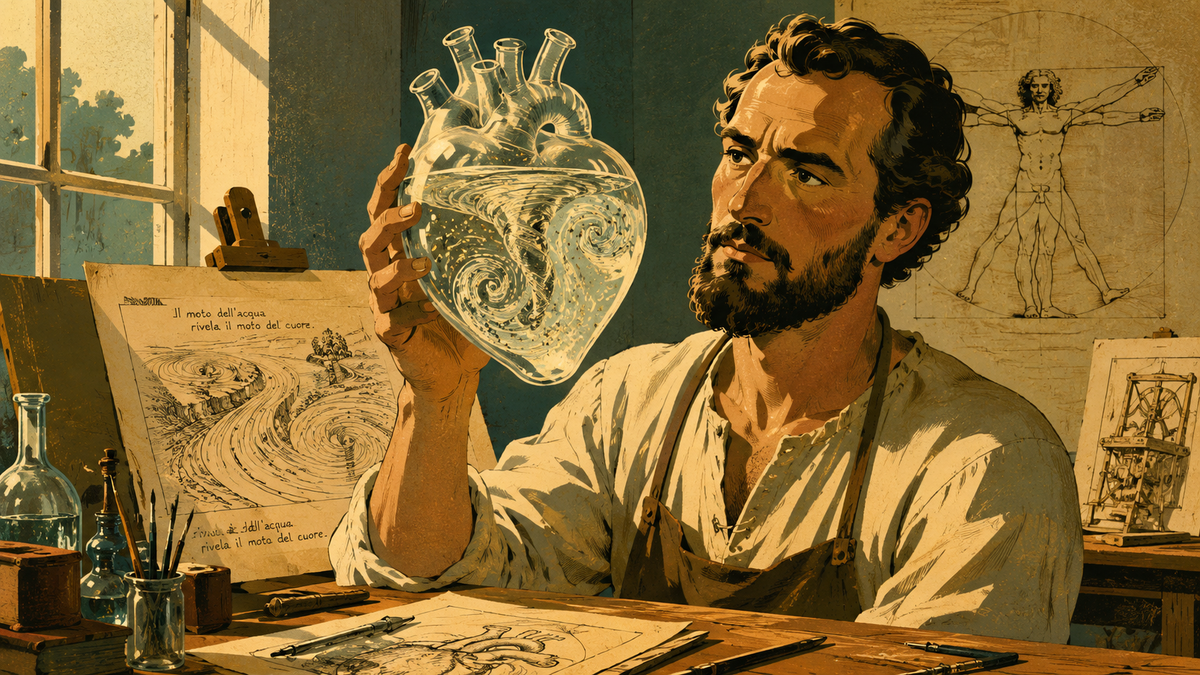
In a workshop in Milan, sometime around 1512, Leonardo da Vinci ran into a wall that no amount of drawing could get him over. He wanted to understand the aortic valve. He wanted to know how the heart, with no muscle in the valve itself, closes that gate cleanly millions of times without a single backward leak. The problem was absolute: he could not see inside a living heart. The chest does not open for curiosity. The valve does its work in the dark.
So he did something no cardiologist would have thought to do, because no cardiologist existed yet, and because his mind did not file knowledge in the drawers we use now. He reached for water.
For years Leonardo had studied how water moves. How it curls around a piling. How it spirals when a river widens. He had filled notebooks with the small turning eddies that form where a current meets open space. He took that, the fluid dynamics of a riverbank, and carried it into the chest. He built a glass model of the aortic root, the bulb just above the valve. He mixed grass seed into water and pumped it through the glass so he could watch the flow. And he saw them: small spiraling vortices forming in the pockets behind the valve, the sinuses of Valsalva, pushing the leaves shut from the side.
He was right. He had no way to prove it, and he died not knowing he was right. In 2014, five hundred years later, a 4D-MRI study confirmed it in living patients. The paper's title is almost flat in its understatement: flow vortices in the aortic root, in vivo, confirming the predictions of Leonardo da Vinci.
He solved a problem in cardiology with a tool from hydraulics. The depth did not come from going deeper into hearts. It came from going wider, then letting one field reach across and touch another.
We have the geometry exactly upside down.
The T is inverted
There is a familiar idea about the ideal modern mind. It is called the T-shaped person. The vertical line is your deep expertise, the one thing you are genuinely great at. The horizontal line across the top is your general awareness, a thin layer of knowing-a-little-about-a-lot that sits over the real skill like a hat.
Look at how that figure is drawn. The breadth is on top, thin, decorative. The depth is the spine. The unspoken message is that the horizontal is the nice-to-have and the vertical is the substance. Be wide enough to make conversation, but make your living going deep in one narrow place.
I think the picture is drawn upside down.
Turn it over. Put the breadth on the bottom, wide and load-bearing, and let the depth rise up out of it. Now the wide part is not a hat. It is the foundation. A tree does not grow tall by sending one root straight down. It grows tall because its roots spread wide and shallow, gripping a huge plate of earth, and the trunk rises out of that spread. Cut the spread and the height has nothing to stand on. The breadth is not the shallow part of the tree. The breadth is the reason the tree can be tall at all.
This is the whole reframe, and it overturns a hundred years of career advice in one move. A specialist's depth sits in isolation. The expert generalist's depth sits in a web. Same depth, completely different value, because one is connected to everything around it and the other is connected to nothing.
Look hard at those two words. Expert. Generalist. The world keeps them in separate rooms. It will call you one or the other, never both, because it cannot picture a person who goes wide and goes deep at the same time. That picture is the premise of everything that follows. The expert generalist is not a dabbler who knows a little about a lot. Her breadth is the expertise. Her command of many fields, and her ability to run a line between them, is itself the rare and trained skill.
We have never quite had a name for her. Malcolm Gladwell gave us three types in The Tipping Point. The Maven, who accumulates knowledge and cannot help sharing it. The Connector, who knows everyone and links the unlinked. The Salesman, who persuades. All three are about moving information through a network. All three describe where you sit in a crowd. None of them describes what happens inside a single mind when many fields meet in one place and start talking to each other.
That is a fourth type. Call her the Synthesizer. She is a dot connector. She takes a pattern from one field and runs it into another, and the run itself is the work. If that sounds like a machine, it should. It is close to what artificial intelligence does, mapping the lines between everything it has been fed. The resemblance is real, and it is exactly why this type matters now. There is one thing the machine cannot do, and it is the thing that decides everything. It cannot synthesize experience and context together, because it has neither. It has the operation and none of the inputs.
Picture two people who each know one subject cold. The first knows only that subject. Her expertise is a tall, lonely tower on an empty field. The Synthesizer knows that subject just as deeply, but she also knows six other fields well enough to see how they rhyme with the first. Her expertise is a tall tower in a city, with roads running out to every other tower. When a problem arrives that does not fit the usual shape, the specialist has one tool. The Synthesizer has an intersection.
Leonardo did not solve the valve by being the best heart-anatomist alive. He solved it by being a man who had also spent years watching rivers, and who could carry the river into the chest. The breadth was the master skill. The depth was just where the breadth happened to surface.
"Jack of all trades, master of none." That is where most people stop. The full saying ends differently: "but oftentimes better than master of one." We kept the insult and cut the verdict. The breadth was the mastery the whole time, and the proverb knew it. We just could not see it, because we were holding the figure upside down.
The clock is running
If this were only a nicer way to think about generalists, it could wait. It cannot wait, because something has started a clock.
For all of human history, narrow depth has been scarce and therefore precious. The person who knew tax law cold, or could read a chest film, or could write flawless contract language, held real value precisely because that depth was hard to acquire and rare to find. You paid for the tower because almost no one had built one.
Artificial intelligence is now deep in every vertical at once. It has read more tax law than any human attorney. It has seen more chest films than any radiologist will see in a career. It does not get tired and it does not specialize, because it does not have to choose. It is the deepest person in the room in every room simultaneously. And when narrow depth stops being scarce, it stops being precious. The lonely tower on the empty field is about to have a machine standing next to it that is taller, faster, and free.
Here is the difference, and it is the whole game. The machine connects dots the same way the Synthesizer does, across a map of everything ever written down. It knows the patterns. It does not know the point. It has read every word published on hydraulics and every word on cardiology, and it still does not make Leonardo's leap, because the leap was not in the text. It came from a man who had stood beside moving water for years and carried what he saw into the chest. That is experience and context fused into a single move, and the machine can do neither half. It has never been in the room. It has never stood at the river. It runs the operation on borrowed text while the Synthesizer runs it on a life. Synthesis of experience and context is the one cognitive act that does not commoditize, because it cannot be scraped. It has to be lived.
So the value is migrating. It is moving off depth-in-one-thing, where the machine now lives, and onto synthesis-across-things, where the machine is lost. The cognitive shape we treated as a liability for a century, the wide, restless, many-fielded mind that could never sit still in one lane, is about to become the most valuable shape there is. And the migration is not coming. It is here.
Benjamin Franklin showed us what this shape does, two hundred and fifty years before we needed the lesson. In 1768, as deputy postmaster for the colonies, he got a complaint that should have stayed a logistics problem: British mail packets were crossing the Atlantic about two weeks slower than ordinary merchant ships. Slower than the amateurs. It made no sense.
A specialist in postal administration would have audited the schedules. Franklin asked a different kind of question, because he was a different kind of mind. He took it to his cousin Timothy Folger, a Nantucket whaling captain. Folger knew exactly why. Whalers followed a powerful current across the Atlantic because the whales gathered along its edges, and the British captains, not knowing it was there, were sailing straight into it and losing the race against their own ignorance. Folger drew the current from memory. Franklin, a printer by trade, had it engraved. The result was the first printed chart of the Gulf Stream.
Look at where that discovery lived. It sat at the meeting point of three of Franklin's worlds. The postal administrator surfaced the problem. The scientist asked why. The printer published the answer. A man who was only one of those three would have missed it. The breadth did not dilute the work. The breadth was the work.
Charlie Munger spent the back half of his life arguing exactly this, and he argued it by name. Speaking at USC in 1994, he told a room of business students:
You've got to have models in your head. And you've got to array your experience, both vicarious and direct, on this latticework of models.
A latticework. Not a tower. A wide, interlocking frame, where each model holds the others up. And he warned what happens to the mind that refuses to build it:
you've got to have multiple models, because if you just have one or two... you'll torture reality so that it fits your models.
One tower, and you bend the world to fit it. A latticework, and you can let the world be what it is, because you have somewhere to put each piece of it. Munger built one of the great fortunes of the century on the conviction that breadth is not the soft skill. Breadth is the structural one.
The craftsman and the sage
There are two ancient pictures of mastery, and they look like opposites.
The first is the Japanese shokunin, the craftsman who gives his whole life to one thing. The knife-maker who has folded steel the same way for forty years. The sushi master who has been told he is still not making the rice correctly after a decade. Here mastery is narrowing. It is the slow burning away of everything that is not the one thing, until what remains is pure. There is something holy in it. The shokunin proves that a single vertical, pursued past the edge of reason, becomes its own kind of infinity.
The second picture comes out of the Hebrew tradition, the sage formed by makhloket, the practice of argument that holds many strands at once. The rabbinic mind does not narrow. It widens. It sets law beside story beside ethics beside grammar and argues across all of them at the same time, comfortable with tension, refusing to collapse a hard question into one clean answer. Here mastery is the opposite move. It is widening. It is the ability to hold the whole field in tension and reason across the gaps.
We are tempted to pick one. Resist the temptation. Both are true, and the inverted T is where they meet. The shokunin gives us the vertical, the willingness to go all the way down where depth is genuinely needed. The sage gives us the horizontal, the wide base that knows where to send the depth and why. The Synthesizer is not the sage instead of the craftsman. The Synthesizer is the mind whose base is wide enough, like the sage's, that depth can rise, like the craftsman's, exactly where it will matter most. You narrow on purpose, from a position of width. You do not narrow because you were never allowed to be wide.
For the ones who were told to pick a lane
If you have spent your life being told that you are unfocused, that you need to specialize, that your problem is you are interested in too many things, I want you to hear what was actually happening.
You were not failing to pick a lane. You were building the base. While you were being told to go narrow, you were going wide, and you were laying down the one foundation that the next era is going to be built on. The hydraulics that would one day reach the heart. The postal route that would one day chart the ocean. The latticework that holds when the single tower falls.
The world spent a century calling your shape a weakness. The world was holding the figure upside down.
You were never unfocused. You were holding the figure the right way up.