The Power of No
We say it apologetically. We over-explain it. We soften it until it means nothing. But every no returns something, and the right one returns everything.

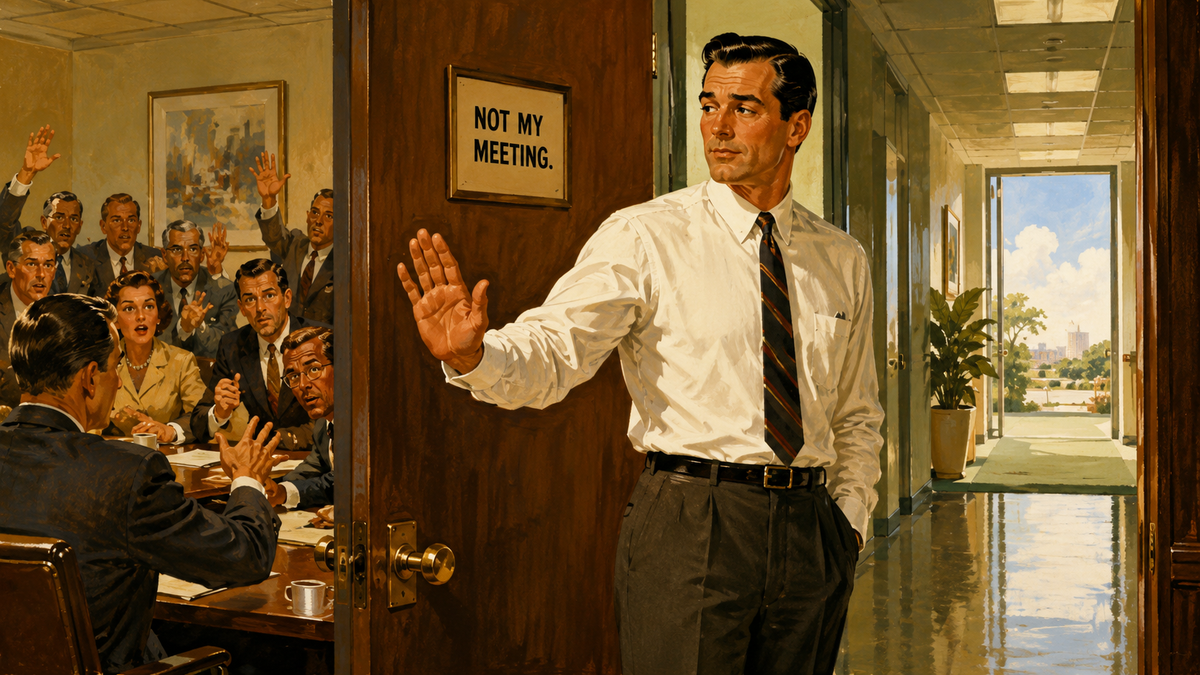
Nobody likes the word no.
We've been conditioned since childhood to hear it as rejection, as a closed door, as the end of something. We say it apologetically. We over-explain it. We soften it until it barely means anything. Or we don't say it at all, and we say yes instead, because yes feels generous and no feels selfish.
That instinct is costing you everything.
What No Actually Returns
Every no you say returns something.
Time. Mental space. The capacity to show up fully for the things you actually committed to. When you say no to the wrong meeting, you get back two hours. When you say no to the wrong client, you get back the energy you would have spent managing a relationship that was never going to work. When you say no to the wrong opportunity, you get back your focus.
There's a name for what you're protecting. The psychologist Roy Baumeister spent years studying what he called ego depletion, the idea that willpower and decision-making draw from the same limited reservoir. Every yes you can't escape keeps drawing from that account. By the end of the day, the person who said yes to everything has nothing left for the things that mattered most. Not because they're weak. Because they spent the tank on the wrong roads.
No isn't a closed door. It's an open one. The question is whether you can see what's on the other side clearly enough to trust it.
No Closes the Decision Tree
I wrote about the cost of deciding, about how every unmade decision is a hidden tax on your energy. The solution I found was building a system in advance, closing the tabs before they drain the battery.
No is the upstream version of that.
When you say yes to the wrong thing, you don't just take on the thing itself. You open an entire decision tree that follows from it. Meetings to schedule. Obligations to manage. Expectations to navigate. Conflicts to resolve. Every one of those is a withdrawal from the same account.
Saying no upstream eliminates all of it. One decision closes a hundred. That's not avoidance. That's leverage.
Greg McKeown, who wrote about the disciplined pursuit of less, put it as cleanly as anyone has:
If it isn't a clear yes, then it's a clear no.
That line does more work than it appears to. It removes the middle ground, the maybe, the let me think about it, the place where most of our energy goes to die. The maybe is the most expensive answer you can give, because it keeps the decision open and keeps you paying for it.
The Fear Underneath
Here's the honest accounting. Most people don't say no because they're afraid.
I've written about fear before, about how it builds walls and calls them wisdom. About how it manufactures limitations that were never real. The person who can't say no is living inside that same story. They're afraid of the confrontation. Afraid of being seen as difficult, or ungrateful, or not a team player. Afraid that the door they close won't open again.
But there's something underneath the fear that's worth naming, because it's harder to see in yourself. We don't just say yes to avoid conflict. We say yes to protect who we believe we are. The helpful one. The reliable one. The person who always shows up. Saying no doesn't feel like declining a request. It feels like betraying an identity.
That's why it's so hard. You're not just turning down a project. You're contradicting the story you tell about yourself. And the mind will pay almost any price to keep that story intact, including the slow surrender of your time, your focus, and your peace.
So you say yes. And then you stay in the yes long after the math has changed, because saying no now feels like it carries even more weight than it did at the beginning.
Fear didn't protect you. It trapped you. The no you were avoiding was never as dangerous as the yes you were living in.
No Is a Filter, Not a Wall
The people who operate at the highest level use no as a first principle, not a last resort. It's how they protect the yes that matters.
This is where no becomes a business strategy, not just a personal one.
Selectivity is what makes premium positioning possible. When you say yes to everything, you signal that your time has no particular value. When you say no freely, clearly, and without apology, you signal the opposite. Better clients follow. Higher prices become defensible. The work gets better because you're doing less of the wrong work and more of the right kind.
There's a counterintuitive truth buried here that the research backs up. Barry Schwartz, studying what he called the paradox of choice, found that more options don't make us happier. They make us more anxious, more paralyzed, and less satisfied with whatever we finally choose. Every yes you add to the pile reduces your satisfaction with all of them. No does the opposite. It narrows the field and deepens your commitment to what remains.
No is how you build a practice worth having.
The Compounding Return
A well-placed no doesn't just protect today. It redirects energy, and redirected energy compounds.
Thirty years of pattern recognition has taught me one thing about this: when one door closes, two better ones open. That's not optimism. It's what selective commitment produces over time. The opportunities that follow a clean no are almost always better than the opportunity you declined, because you show up for them with a full tank instead of a depleted one.
This is also where the sunk cost trap does its quietest damage. The longer you stay in a yes, the more you've invested, and the more invested you are, the harder it becomes to leave, because leaving feels like admitting the investment was wasted. So you keep paying, not because the future looks good, but because the past feels too expensive to walk away from. The math only gets worse from there.
The yes you save your no for is worth more than ten yeses you gave away for free.
How to Say It
No is a complete sentence.
You don't owe anyone a lengthy explanation. You don't need to apologize for it. You don't need to soften it into something unrecognizable. Clean and direct is the kindest form it takes, for you and for the person on the other side. The long, hedged, over-explained no isn't more respectful. It's just fear, dressed up as courtesy, asking for permission it doesn't need.
The relationship can survive a well-delivered no. What it cannot always survive is the slow erosion of a commitment you never had the courage to decline, the resentment that builds quietly while you keep showing up for something you should have walked away from.
Say it early. Say it clearly. Say it without the theater of over-explanation.
And then let it stand.
The Declaration
We have been taught to hear no as a negation. It isn't.
You have a right to say no. Not a privilege you earn, not permission someone grants you, but a right that belongs to you simply because your time and your life are your own. We forget this. We act as though every request carries an obligation, as though declining requires justification. It doesn't. The right to say no is built into the fact that the hours are yours to spend.
And it's more than a right. It's something you owe yourself. Nobody else is going to guard your time, your focus, or your peace. If you won't say no on your own behalf, you are quietly agreeing that everyone else's priorities matter more than your own. That's not humility. That's abandonment, and you're the one being abandoned.
No is a declaration. Of what you value. Of where your attention goes. Of the life you are building and the work you are protecting. Every no you say is a yes to something that matters more.
That's not selfishness. That's stewardship.
No is not the end of the conversation. It is the beginning of the right one.