Elephant or Octopus
An octopus with eighteen months to live outsmarted a room full of humans running night shifts to catch it. What that says about preparation, urgency, and why expertise so often funds the very delay it should prevent.

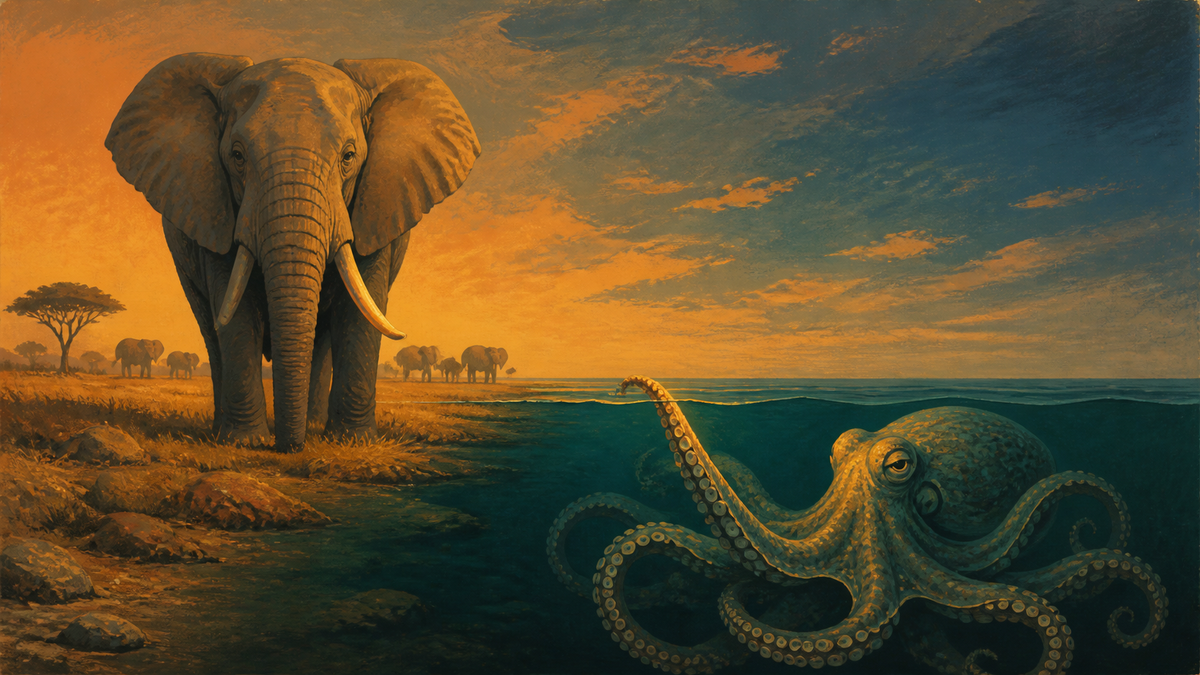
In 2008 the staff at the Sea Star Aquarium in Coburg, Germany, began sleeping on the floor.
The building's power kept failing. That was not a minor inconvenience. When the electricity dropped, the filtration pumps stopped, and when the pumps stopped, every animal in the building was on a clock. Electricians were called. The blackouts continued. So on the third night the staff took shifts in the dark, waiting to catch whatever was doing this.
What they caught was an octopus named Otto. He had been hauling himself up the side of his tank and firing a jet of water at a low-hanging bulb that bothered him. The water shorted the circuit. The light went out. Staff also reported him throwing rocks at the glass and rearranging the contents of his tank, in the director's words, to suit his own taste better.
Otto's account comes from the aquarium and the press, not from a journal. But the behavior itself is documented elsewhere. Peter Godfrey-Smith reports the same thing at the University of Otago in New Zealand, where an octopus learned to kill the lights the same way, and where it became expensive enough that the animal was released back into the wild. Two aquariums, two hemispheres, two animals who never met and never could have. Same solution.
Godfrey-Smith notes that they do it when no one is watching.
Otto was around two years old. For an octopus that is most of a life. He did not learn this from his mother, because he never met her. He did not learn it from another octopus, because octopuses do not teach and mostly do not tolerate each other's company. Whatever Otto knew about light bulbs and water pressure and human schedules, he worked out alone, from scratch, inside about eighteen months.
The last common ancestor we share with an octopus lived roughly six hundred million years ago and was something wormlike, with barely a nervous system to speak of. Nothing about an octopus mind is inherited from a shared source. It was built separately, on a different body plan, in a different medium, by a different route. And we still look at it and recognize a mind.
What an elephant inherits
Our last common ancestor with an elephant is about one hundred million years back, which is close by comparison. And an elephant's intelligence looks nothing like Otto's.
In 2001, Karen McComb and colleagues published a study in Science on matriarchs in African elephants. They found that adult females can recognize roughly one hundred other adults spread across about fourteen families, roughly the same range a human being manages. Not categories. Individuals. And they found that families led by older matriarchs had higher reproductive success than families led by younger ones.
The clearest illustration came from a drought.
In 1993, Tarangire National Park in Tanzania went dry. Infant mortality that year rose from a two percent annual average to twenty percent. But it did not rise evenly. Families led by matriarchs aged thirty-eight and forty-five left the park to find water. A group led by a thirty-three-year-old stayed. The families that left lost far fewer calves.
The researchers concluded that the older females were drawing on something the younger one did not have. Tanzania had a severe drought from 1958 to 1961. The matriarchs who were old enough to have lived through it had learned the routes out. Thirty-five years later, they used them.
That is knowledge in the most literal sense of the word. Accrued. Held in a body, carried forward through decades, and spent at the exact moment it was needed. The thirty-three-year-old was not stupid. She was young. She had not been given the map, so she did not have it, and calves died.
Built twice
Godfrey-Smith calls cephalopods an independent experiment in the evolution of large brains and complex behavior. He is careful about this. If we ever make contact with an octopus mind, he says, it is not through kinship. There is almost no kinship to work with. It is because evolution built minds twice.
He also points out that nearly twice as many nerve cells live in an octopus's eight arms as in its brain, which should tell you how little the arrangement resembles ours. He describes cephalopod minds as the most other of all.
Intelligence is not one thing with one address. It arrived at least twice by unrelated roads, and the two versions do not look alike, do not work alike, and are not solving the same problem.
The elephant is cumulative. It lives sixty or seventy years, it remembers, it transmits, and its ceiling is set by how much it inherited. A matriarch is a library.
The octopus is isolated. One to two years, dead after reproducing, no mother, no teacher, no tradition. Its ceiling is set by that isolation. Everything it will ever know, it invents.
Why the octopus is fast
The temptation is to read Otto as the better processor. He is not.
The octopus is fast because it has no other option. It has no elders to consult and no time to wait for a second opinion. Not acting is not caution. Not acting is death. Every octopus in the ocean is operating under a deadline that never lifts, and it knows the deadline the way it knows water.
Its urgency is structural. It is not a philosophy, not a discipline, not a personality trait it developed. It is a condition of the body.
Urgency is the thing we most admire in ourselves and least understand about ourselves. We treat it as character. It is almost always circumstance.
What depth costs
Every advantage the elephant has is also a buffer. Memory is a buffer. Savings are a buffer. Reputation is a buffer. Twenty years of pattern recognition is an enormous buffer, and it is the one nobody argues with, because it looks exactly like competence.
And every buffer is permission to defer.
The elephant can wait. That is precisely what makes it an elephant. It can wait, consider, draw on the drought of 1958, and move when moving is correct. That patience is real and it saves calves.
But run it forward into a life like yours or mine and the same mechanism produces something else entirely. The person who has done the work for twenty years does not need to start today. They can start next quarter and still finish faster than someone starting now. That is not a delusion. It is arithmetic, and arithmetic is the trap.
Depth removes necessity. Expertise does not solve the problem of not starting. It funds it.
Seneca had this two thousand years ago in On the Shortness of Life. His argument was not that our lives are short. It was that we squander what we are given and then complain about the size of the allowance.
It is not that we have too little time. It is that we waste so much of it.
The octopus cannot waste it. That is its only real advantage, and it came without a choice.
The ancestor we invented
There is a line that gets quoted constantly in gyms, locker rooms, and leadership talks. We do not rise to the level of our expectations, we fall to the level of our training. It gets attributed to Archilochus, a Greek soldier-poet of the seventh century BC.
He never wrote it. There is no classical source for it at all. It appears to have grown out of modern athletic and military culture and then been handed a Greek name to give it weight.
What Archilochus actually left us, in one of the few fragments that survives under his name, is a poem about throwing away his shield.
He drops it by a bush while running from a fight. Some enemy soldier is now happily carrying it around. And Archilochus is unbothered, because he got out alive and a shield is a replaceable object. He will buy another one just as good.
That is the man preparation culture adopted as its patron saint. He wrote about ditching his gear to survive the afternoon.
He is not the elephant. He is Otto. Improvise, discard, live, deal with tomorrow tomorrow.
And we did not want that, so we invented an elephant and put his name on it. We wanted an ancestor who trained in the dark for years, and when the record did not supply one, we manufactured him and quoted him for decades.
I find that more instructive than any advice the fake line contains. We admire preparation enormously. We just do not do it, and we would rather build a monument to it than perform it.
The men who actually prepared
The real record is less quotable and more useful.
Sun Tzu, in the first chapter of The Art of War, argues that the general who wins is the one who makes many calculations before the battle, and the general who loses is the one who makes few. Before. Not during.
Helmuth von Moltke the Elder is remembered for the opposite point. In Über Strategie, written in 1871, he wrote that
no plan of operations extends with any certainty beyond the first encounter
with the main enemy forces, and that only an amateur imagines a campaign as the consistent execution of an idea worked out in advance.
That gets repeated as an argument against planning, usually in a mangled paraphrase that Moltke never said. It is the reverse. Moltke was among the most meticulous planners in military history. He held that the commander's primary job was extensive preparation for every outcome he could imagine, precisely because he knew the plan itself would not survive contact.
He prepared exhaustively for a moment he knew would break the preparation. That is the whole discipline.
The coconut
One more animal, because it complicates everything I have said.
In 2009, Julian Finn, Tom Tregenza, and Mark Norman published a paper in Current Biology on veined octopuses off Sulawesi and Bali. Across five hundred diver hours they watched twenty animals, and they saw something that had not been reported in any invertebrate. The octopuses were collecting coconut shell halves, stacking them, and carrying them across the seafloor for distances up to twenty meters, using an ungainly gait the researchers named stilt-walking.
While it is being carried, the shell provides no protection at all. It costs energy. It leaves the animal exposed. The only benefit is later, when the shells get assembled into a shelter that is not needed yet.
An animal with eighteen months and no teacher, carrying something useless across open ground for a threat that has not arrived. Chop wood, carry water, and no one told this one to.
So preparation is not the elephant's inheritance. It is not a privilege of long life or accumulated memory. It is available to the short-lived and the isolated, and it costs them more, and some of them do it anyway.
Which removes the last excuse.
I have spent thirty years in live production. During a show, in the 90 minutes where the only option is to keep it alive, I am the octopus. Improvising, discarding, solving problems that were not on any list, moving because not moving is failure. It looks like the impressive part. People tell me so afterward. It is the easy part, and it is not the one that mattered.
Anyone can be sharp under a gun. The gun forces it. What I am actually spending in those 90 minutes is work done months earlier, alone, when nothing was forcing anything and no one was watching.
Jacob Riis put it better than I can.
When nothing seems to help, I go and look at a stonecutter hammering away at his rock, perhaps a hundred times without as much as a crack showing in it. Yet at the hundred and first blow it will split in two, and I know it was not that blow that did it, but all that had gone before.
The octopus is fast because it must be. The elephant is wise because it lived long enough. Neither one chose anything.
Preparation is the only intelligence that has to be chosen. That is why so little of it gets done.