The Fifth P
Profit is not the engine. It is what the engine produces.

That distinction sounds small until you try to build a business around the wrong one. Chase profit directly and you will make decisions that undermine the very thing that generates it. Chase product, process, and people with the right foundation underneath them, and profit follows. Not always fast. But reliably.
A friend of mine pushed back hard on that when I published The Four P's last month. Sharp guy, experienced, someone who has built real things. His argument: profit has to come first because without cash flow nothing else matters. No oxygen, no company.
He is not wrong. But he is looking at the output and calling it the engine.
Tracing It Back
In The Four P's, I drew the framework this way: People at the foundation, load-bearing and beneath the sequence. Product, Process, and Profit stacked on top in that order. Each one depending on the one beneath it.
The argument for that hierarchy is simple when you trace it backward. Cash flow keeps the doors open. Cash flow comes from profit. Profit comes from revenue. Revenue comes from sales. Sales come from product. And none of it moves without the right people holding the whole structure up.
You cannot manufacture profit directly. You can only create the conditions for it. Product is the first condition. People are the ground it stands on.
My friend is not wrong that cash flow is oxygen. Run out of it and everything stops, no matter how good your product is, no matter how solid your foundation. But oxygen does not create itself. You have to build the engine that produces it. And that engine is product.
Here is what I left out of the first piece. And it changes how the whole framework works.
The Gap Between Quality and Revenue
There is something that lives between a great product and the profit it should generate. Something that does not appear on any org chart or business plan. Something I have watched founders and operators ignore for years because they never named it, so they never managed it.
Perception.
Not reputation exactly. Not marketing exactly. The specific, living belief your customer holds about the quality of what you make or do. That belief is what determines how hard the engine runs. It is the multiplier between a great product and the revenue that product deserves. And most businesses treat it as an afterthought, if they treat it at all.
The best product in the room does not always win. The product people believe is the best very often does.
I know how that sounds. It sounds like I am telling you to invest in smoke and mirrors. I am not. This is not a cynical observation. It is a practical one. And if you have ever watched an inferior competitor outsell you, this is likely why.
Al Ries and Jack Trout spent decades studying how markets actually work and landed on something that makes a lot of product builders uncomfortable. "Marketing is not a battle of products," they wrote. "It's a battle of perceptions." Most people read that and think it means quality does not matter. That is not what it means. It means quality alone is not enough. The perception of quality is what the market is actually responding to.
"In politics, the perception is the reality. So, too, in advertising, in business, and in life." — Al Ries, Positioning: The Battle for Your Mind
This is where market psychology enters the room and most business conversations stop. But I think it is exactly where the most important conversation begins.
We like to believe we are rational actors. We evaluate features, weigh options, make informed choices. Daniel Kahneman spent a career proving that is not how we actually work, research the Nobel committee eventually recognized. His conclusion was that the mind operates in two systems: one fast, intuitive, and emotional, the other slow, deliberate, and analytical. The fast system handles roughly 96 percent of our decisions, most of them made before the slow system ever gets involved. We feel first. We rationalize second. Every seasoned salesperson knows this. Not every founder does.
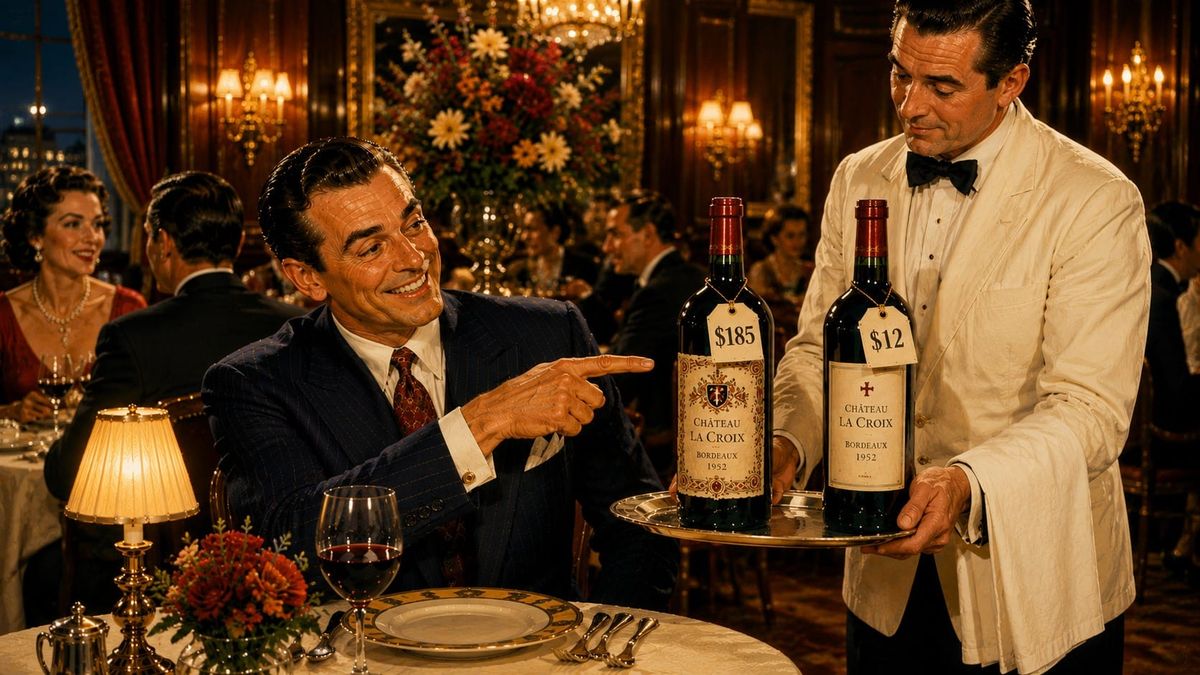
The restaurateur Keith McNally tells a story in his memoir that proves the point better than any study could. One night in 2000 at his restaurant Balthazar, four Wall Street businessmen ordered the most expensive red on the list, a $2,000 bottle of Château Mouton Rothschild. At nearly the same moment, a young couple ordered the cheapest red in the house, an $18 Pinot Noir. Both bottles were poured into identical decanters at the waiter's station. And then they were carried to the wrong tables.
Nobody noticed. The businessman who ordered the Rothschild fancied himself a connoisseur, and as he tasted the $18 wine he believed was a First Growth Bordeaux, he held forth to his guests about its purity. A few tables away, the young couple sipped a $2,000 wine they believed was cheap and jokingly mocked the mannerisms of wine snobs.
Sit with that. The expert, the man who prided himself on his palate, tasted an $18 wine and experienced two thousand dollars of pleasure, because that is what he believed was in his glass. His belief did not change his opinion of the wine. It changed the wine. Or rather, it changed the only version of the wine that ever mattered: the one he experienced.
This is not a metaphor. It is measurable. In 2008, researchers from Stanford and Caltech ran a study using brain imaging while subjects tasted wines they believed were priced differently. The wines were identical. The pleasure centers of the brain activated more intensely when subjects believed they were drinking the expensive bottle. The perception did not just change what people reported. It changed what their brains actually felt.
"Price is changing people's experiences with a product, and therefore the outcomes from consuming it." — Baba Shiv, Stanford Graduate School of Business
McNally's connoisseur was not lying. His brain really did deliver him the pleasure of an expensive wine. The belief was the experience. That is not a marketing trick. That is how human beings are built.
I see this in my own work constantly. A conference room with beautiful audio and no visible speakers tells attendees something about the quality of the meeting before a single word is spoken. A restaurant that gets the first thirty seconds right earns a longer leash on everything that follows. A consulting firm whose materials look considered and deliberate signals something about how carefully they will handle your problem. None of that is the product itself. All of it shapes how the product lands. All of it determines how hard the engine runs.
The dangerous version of this is the operator who invests in the signal without building the thing the signal is pointing to. I have watched that play out. It works once, maybe twice, and then it collapses. The market is patient but it is not forgiving. You can sell perception, but you cannot sustain it without the product underneath. The two have to be built together, with equal seriousness, neither one treated as an afterthought.
This is the discipline most businesses skip. They build the product carefully and then treat the communication of that product as a cost center, something to get to later. Or they go the other direction and build a beautiful brand around something that cannot actually deliver. Both paths lead to the same place. A short run followed by a hard stop.
The businesses I have watched succeed over the long haul are the ones that hold this tension well. They build real quality and then invest seriously in how that quality is understood and experienced by the customer. They convert a great product into consistent, durable profit, and consistent durable profit into the cash flow that keeps the doors open and the mission alive. Not because they manipulated anyone. Because they respected their customer enough to make sure the quality they built was the quality the customer actually received, from the first impression all the way through.
What BlackBerry Teaches Us
BlackBerry built a genuinely excellent product. Enterprise security, physical keyboards, email integration that was years ahead of its time. For a specific window, nothing in the market came close. The quality was real, validated by millions of users and entire industries built around it.
Then the story changed.
When Apple released the iPhone in 2007, BlackBerry's co-CEO Jim Balsillie watched the announcement and told his partner Mike Lazaridis two words: "We'll be fine." Lazaridis agreed. He was convinced the keyboard was irreplaceable, that the touchscreen was a gimmick, that their users would never abandon what worked. He was focused entirely on the product he had built and paid almost no attention to the story the market was beginning to tell about it.
Apple did not beat BlackBerry by building a more secure device. For years the iPhone was less secure. Apple won by changing what people believed a phone should be and feel like. The touchscreen, the app ecosystem, the design language, all of it constructed a new perception of what the future looked like. And BlackBerry, convinced their product quality would speak for itself, kept building a better version of yesterday while the market moved toward tomorrow.
By the time BlackBerry understood what was happening, the perception gap had become a chasm. Not a product gap, not initially. A perception gap. They lost the story before they lost the market. And when they lost the market, they lost the revenue. When they lost the revenue, they lost the profit. When they lost the profit, they lost the cash flow. The whole chain collapsed from the middle out.
The quality did not disappear. The belief in it did. And everything else followed.
I think about that every time I am tempted to let my work speak for itself. It is a tempting instinct when you know the quality of what you have built. But products do not speak for themselves. People speak for them. Experiences speak for them. Stories speak for them. If I am not actively shaping that story, someone else will, and they may not tell it the way I would.
The Framework, Extended
In The Four P's I drew the diagram this way: People at the foundation, then Product, Process, and Profit stacked on top.
The diagram needs one addition.
Between Product and Process, between the thing you built and the machine that scales it, sits Perception. It is not a brand strategy. It is not a marketing budget. It is the active, ongoing work of making sure what your customer believes about your product matches the reality of what you built. Close that gap and the engine runs hard. Let it widen and even a great product loses ground it should never have lost.
Remember McNally's connoisseur. When the truth came out, when he learned the wine he had praised was the $18 bottle, he did not defend his earlier delight. He said, "I thought that wasn't a Mouton Rothschild." His companions nodded along. The moment the perception broke, every man at the table rewrote his own experience to match the new reality, and pretended he had seen it coming.
That is what perception does. It governs the experience completely, right up until it shatters. And when it shatters, it takes the revenue, the loyalty, and the story down with it. BlackBerry learned that. The connoisseur learned it over dinner. The lesson is the same at every scale.
Cash flow is oxygen. Profit produces it. Product drives profit. Perception determines how much. People make it all possible.
My friend is right that without cash flow the doors close. I am right that product is the engine. And neither of us was accounting for the fifth P sitting quietly between them, governing how much of one becomes the other.
Perception is not spin. It is not manipulation. It is the honest work of making sure the quality you built is the quality your customer experiences and believes in. It is closing the gap between what you made and what the world understands you made.
Build real product. Build real perception of that product. In that order, always.
The founders and operators who hold both of those truths at the same time are the ones who turn quality into profit, profit into cash flow, and cash flow into the freedom to keep doing work that matters.
That tension, and how to manage it, is where we are headed next.