The Hammer and the Bloat
A shift scheduling tool I paid for for years quietly stopped doing the one thing I bought it for. One weekend and two free hosting accounts later, I had replaced it. The moat most SaaS platforms stand on is a puddle.

I've been paying for a shift scheduling tool for years. When I signed up, it did one thing, and it did it well. My team could see their schedule, clock in and out, and at the end of the week I had a report that told me what I needed to know. Simple. Clean. Useful.
Somewhere along the way, it stopped doing that thing.
Not all at once. That's never how it happens. A feature got moved. Then renamed. Then folded into a new module that required a higher subscription tier. Then the part I actually used got quietly deprecated while the company shipped an AI assistant I didn't ask for, a dashboard redesign that made everything harder to find, and an integration with a project management tool I've never heard of and will never need.
I kept paying. I kept working around it. I trained my team on the workarounds. That's what you do when switching costs feel higher than the pain of staying.
One Saturday I got tired of it. I opened Claude Code, spun up a free Vercel account and a free Supabase account, and by Sunday night I had my own shift scheduling and time tracking app. I call it Seikabo. It does exactly what I need. Nothing more. It will stay that way because I am the only person it has to answer to.
A hammer is a hammer
My dad was a general contractor. I built houses with him as a teenager, framing walls, running trim, learning how to swing a hammer without hitting my thumb. When you do hit your thumb, and you will, you feel it in your whole arm before you feel it in your hand. A specific, stupid, avoidable kind of pain. You remember it every time you pick up a hammer after that.
A hammer is for hitting nails. That is the whole job. It has been the whole job for thousands of years. Nobody has improved on the design because there is nothing left to improve. It does one thing, does it well, and it stays a hammer.
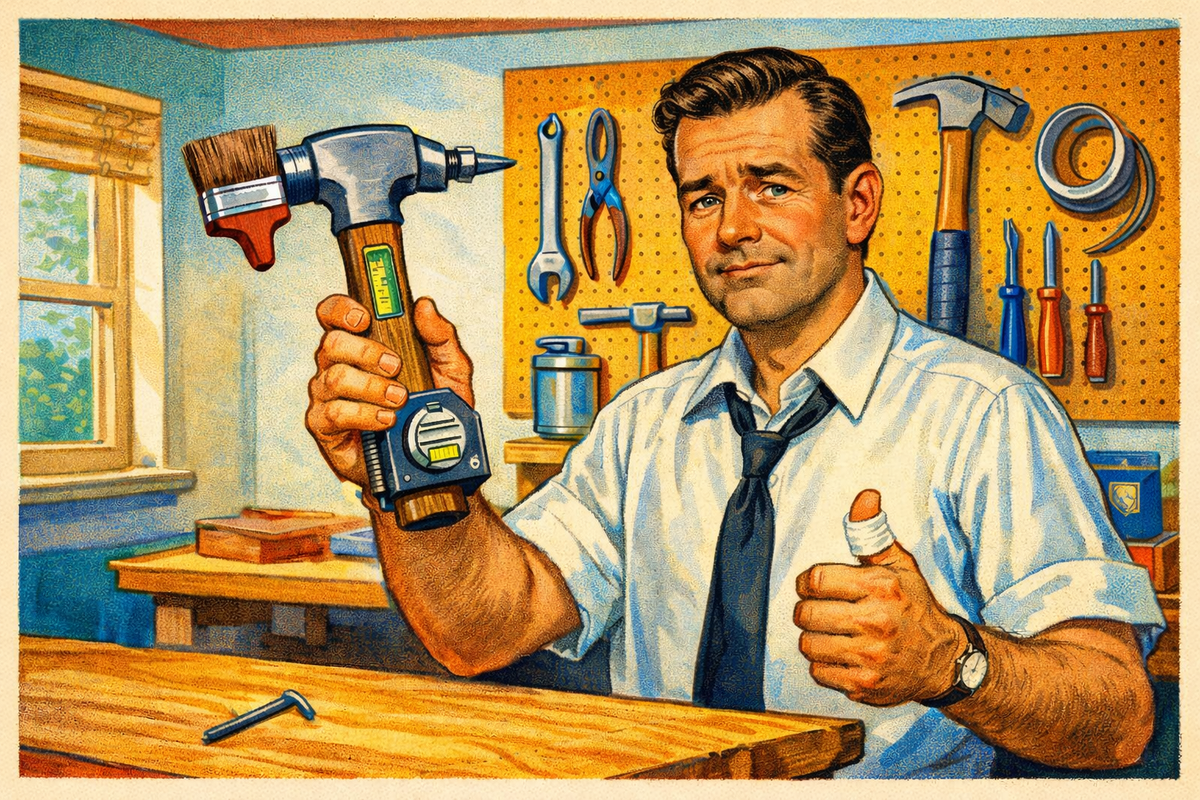
Now imagine someone looks at that hammer and decides it should also be a paintbrush, a screwdriver, a level, and a tape measure. They weld a brush onto one side of the head, a Phillips bit onto the other, a bubble vial into the handle, and a retractable tape into the grip. They hand it back and tell you it's better now. More versatile. A complete solution for the modern jobsite.
You swing it at a nail. The balance is wrong. The weight is off. The head is so cluttered you can't swing it straight.
You hit your thumb.
That is the feeling I have every time I log into most of the software I pay for.
How SaaS lost the plot
I don't think anyone set out to ruin their own product. There are no villains here. I think money makes people tone deaf to the customer, and the tone deafness compounds until the original purpose of the tool is barely visible under all the additions.
It starts simply. A founder sees something broken and builds a tool to fix it. Small, focused, useful. The early customers love it because it solves their problem without asking them to learn a new way of thinking. It just works.
Then the company raises a round. The cap table fills with people who need a return, and returns require growth, and growth requires expanding the market. Expanding the market means new features for new customers with different problems. The founder is still listening, but to a different room now. The investors want the graph going up and to the right. The board wants customer count and revenue per seat climbing. The original customer is still there, still paying, but their voice gets quieter every quarter because they are not the voice that controls the next funding round.
Nobody notices the drift at first. Features keep shipping. The changelog keeps growing. The team grows. The office gets bigger. Everything looks like progress from the inside.
But the thing you bought the tool for starts to drift. Not because anyone decided to break it. Because nobody in the building is pointed at it anymore. The roadmap is driven by whatever gets the company closer to the next valuation milestone. The original problem that launched the whole thing becomes one item in a backlog of dozens, deprioritized against features that serve markets the company hasn't even entered yet.
The founder is not a bad person. They are just listening to the loudest voice in the room, and that voice is no longer the customer they started out serving.
The bloat tax
The obvious cost is the price. The invoice goes up every year while the product gets harder to use.
The less obvious cost is the cognitive load. Every new feature is a tax on your attention, even if you never touch it. You have to learn where it lives in the interface. You have to decide whether it applies to you. You have to explain to your team why you are not using it. Settings nobody needs. Onboarding flows designed for teams of fifty when you have a team of five. Dashboards built to justify the next funding round rather than help you get through the next workday. Integrations with tools you do not use, advertised as though their existence alone is a benefit.
Every release note is an invoice for your time.
Then there is the quiet cost, the one nobody talks about. The original feature breaks. Or disappears. Or gets moved three menus deep into a tier you were not on before. The thing you bought the tool for silently stops working while the company ships its fourth dashboard redesign and an AI assistant you did not ask for.
You keep paying because switching is expensive. You keep paying because you have trained your team and retraining them feels like admitting defeat. You keep paying because you keep hoping someone in the building will notice the thing they broke and fix it.
They will not. The room they are listening to is not your room anymore.
I have watched this happen with project management tools, communication platforms, invoicing software, CRM systems, and now shift scheduling. The pattern is always the same. A tool that worked becomes a tool that almost works, then a tool that requires constant workarounds, then a tool you resent but cannot quite afford to leave.
The moat is a puddle
Here is what has changed, and it has changed faster than most people realize.
A reasonably smart operator can now build their own tools in a weekend for almost nothing. I am not speaking theoretically. Seikabo cost me the price of Claude Code credits and two free hosting accounts. One weekend. Saturday to build the core. Sunday to clean it up and make it usable for my team.
It does what I need it to do. My team can see their schedule, clock in and out, and I can export a report at the end of the week. That is the entire feature set. No dashboard. No AI assistant. No integrations with tools I do not use. No roadmap driven by a board I do not answer to.
It works, and it will keep working, because I am the only person it has to serve.
This is not a toy. This is a real tool doing a real job in a real business, and it cost less to build than one month of the subscription I was paying for the tool that stopped working.
I run Arkira Labs to build tools like this. Not for venture scale. Not for a TAM that justifies a pitch deck. For real problems that real operators have, where the existing solutions have bloated past the point of usefulness. A hammer is a hammer. I am building hammers.
This is not going to stay a niche thing. It is going to be how a lot of small operators run their businesses in five years. Not everyone will build their own software, but enough will, and the rest will start asking much harder questions about why their tools keep getting worse while the invoices keep getting bigger.
The platforms that built their moat on the assumption that it would be too hard for a customer to build this themselves are about to find out the moat is a puddle.
A word to the people writing checks
The next decade is not going to reward the platforms that bolted on AI to justify a valuation. It is not going to reward the companies that expanded into every adjacent market to hit a revenue target. It is going to reward small, sharp, honest tools built by people who can still hear their customer.
Fund those people. Let them stay small if small is what serves the customer. Let the tool be a hammer. Then get out of the way.
Build the hammer you need
If you are reading this and you have been paying for software that no longer does what you bought it for, you already know. You have worked around the broken parts for years. You have trained your team on workarounds that should not exist. You have absorbed the bloat tax on behalf of a company that stopped listening to you a long time ago.
You have a weekend. You have a problem. You now have tools that make the gap between those two things smaller than it has ever been.
Build the thing you actually need. Keep it a hammer. You will know when you have it right because it will feel like swinging a tool that fits your hand, does the job it was made for, and nothing else.
That is what good tools feel like. We forgot for a while. We do not have to keep forgetting.