Luddites Lose
Every generation has its Luddites. Every generation is wrong. The craft always survives. It just doesn't wait for permission.

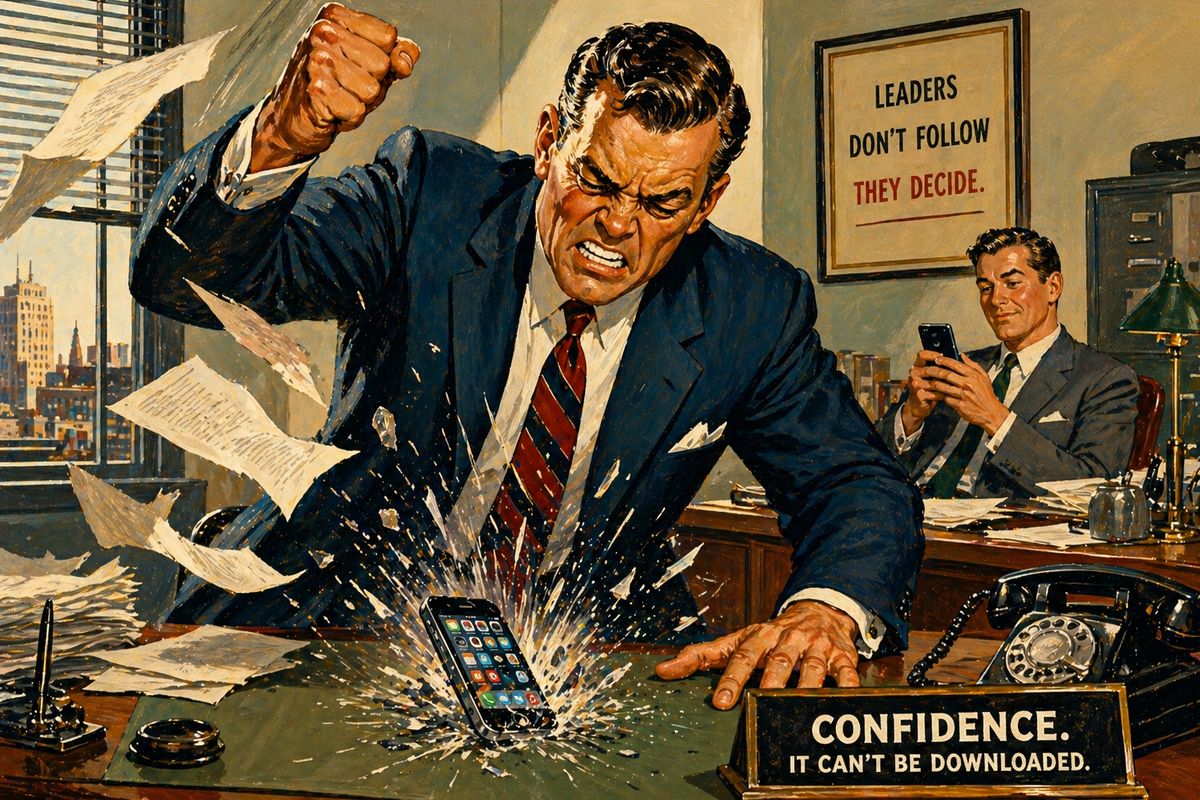
Every Generation Gets a New Devil
There is a pattern older than the recording industry, older than the automobile, older than the electrical grid. It goes like this: a new technology arrives, and a faction of people who built their lives around the old way decide it is the enemy.
They are always wrong.
Not sometimes. Not usually. Always.
The word technology traces back to the ancient Greek "techne," which means craft, and "logos," which means the study of something. Technology is literally the study of craft. It is not a threat to what humans make and do. It is the ongoing evolution of how we make and do it. The Luddites, in every era, miss this. They see the new tool and imagine the end of the thing they love. What they cannot see, because fear collapses imagination, is that the thing they love is about to grow.
The original Luddites were English textile workers in the early 1800s who smashed weaving machines because they believed the machines would take their jobs. The movement is named after a possibly mythical figure called Ned Ludd, who was said to have smashed two stocking frames in a fit of rage. Some of those workers did lose their jobs. The textile industry did not die. It exploded. The same story played out when electricity arrived and candle makers predicted darkness. When the automobile appeared and stable owners predicted the end of transportation. When recorded music emerged and concert promoters predicted the end of live performance. Each time, the people who picked up the new tool early didn't just survive the transition. They defined what came after it.
The resisters became footnotes.
There is something almost poetic about the consistency of it. Every generation produces a new set of people absolutely certain that this time is different, that this particular technology is the one that finally breaks the pattern. They make the same arguments, feel the same fear, and arrive at the same outcome. The craft survives. The industry evolves. The early adopters inherit the expanded version of the world the resisters were trying to protect.
The Music Industry Has Died a Hundred Times
Gareth Murphy's book Cowboys and Indies traces the history of the recorded music business from its earliest days through the modern era. What it reveals, across decades of disruption, is the same movie playing on repeat. Every format shift, every new distribution model, every technological leap was met with the same alarm. The industry is finished. The artists will starve. The craft will die.
And every single time, the industry pivoted. And grew.
Radio was going to kill record sales. It didn't. Television was going to kill live performance. It didn't. The cassette tape, the CD, the MP3, streaming: each one was a death sentence that turned into an expansion of the market. The people who adapted early didn't just survive. They shaped what the industry became. The people who resisted longest paid the highest price, and they paid it not because the technology was cruel, but because they confused evolution with extinction.
I have spent thirty years in live event production. I have watched this pattern from close range, in rooms where the decisions got made and in the aftermath when those decisions played out. The resisters always had the same argument: this will cheapen the craft. And the early adopters always had the same advantage: more time, more reach, more capacity to do the work they actually cared about.
The Biggest Shift of My Lifetime
Nothing I have watched compares to what is happening right now with artificial intelligence.
The fear response is identical to every previous cycle. AI will replace artists. AI will replace lawyers. AI will replace designers, developers, writers, architects. The craft will be hollowed out. What took skill will become a commodity.
I understand the fear. I do not share it.
What I actually see, from inside the work, is something different. The early adopters are not being replaced. They are being multiplied. I am an experience architect and audio design professional. I am also, now, a software builder. I use AI to do legal work that would have required an attorney and a waiting room and an invoice that would have made me wince. I get time back. I get capability back. I get to do more of the work that actually matters because the work that used to slow me down no longer does.
The craft did not get cheaper. The craftsman got more powerful.
That is the thing the Luddites cannot see from where they are standing. The tool does not replace the judgment, the taste, the relationships, the thirty years of knowing what a room needs to feel right. The tool just handles more of the carrying so the person with the judgment can use it more freely. I wrote about this at length in Human in the Loop, but the short version is this: the human is still the point. The AI is just a better instrument in the hands of someone who knows how to play.
Fear Is a Failure of Imagination
A hundred years ago, a cell phone would have looked like witchcraft. The person who could conjure a voice from a glass rectangle, speak to someone on the other side of the world, and see their face in real time would have been considered either a miracle worker or something far more sinister. We do not think about that now because we grew up in the world where it is ordinary. But someone had to be the first person to trust it. Someone had to see a telephone and decide it was a tool, not a threat.
That leap, from fear to curiosity, from protection to exploration, is the only thing that separates the people who shape the future from the people who get shaped by it.
The resisters are not bad people. They are usually skilled people, people who worked hard to get good at something and who feel that something slipping. That feeling is real. The conclusion they draw from it is wrong. Because the thing they are actually good at, the judgment, the taste, the craft, does not slip. It compounds. The new tool just means they can apply it to more, do it faster, reach further, and spend less of their finite time on the work that never required their best thinking in the first place.
Every earth-shattering technology shift has, on balance, made human life larger. Not without disruption, not without real cost to the people caught mid-transition, but larger. The people who understood that earliest got the most out of it. The people who understood it last, or never, gave up ground they did not have to lose. And here is the part that should matter most to anyone who takes their craft seriously: the early adopters did not love their craft less. They loved it enough to follow it into the new world instead of guarding the door of the old one.
The pattern is not subtle. It is not a matter of debate. It has repeated across industries, across centuries, across every domain where human beings have made things and then found a better way to make them.
The question is not whether the technology will change your industry. It will. The question is whether you will be the person shaping what it becomes, or the person explaining why you didn't see it coming.
Luddites lose. They always have. The craft always survives. It just doesn't wait for permission.