Vision Alone Never Built Anything
Why do brilliant founders with perfect vision still fail? Because they confuse seeing the destination with knowing the path. The architect draws the house. The contractor knows the foundation comes first. Leadership is having the humility to listen.
"It doesn't make sense to hire smart people and then tell them what to do. We hire smart people so they can tell us what to do." ~Steve Jobs
The Architect and The Contractor
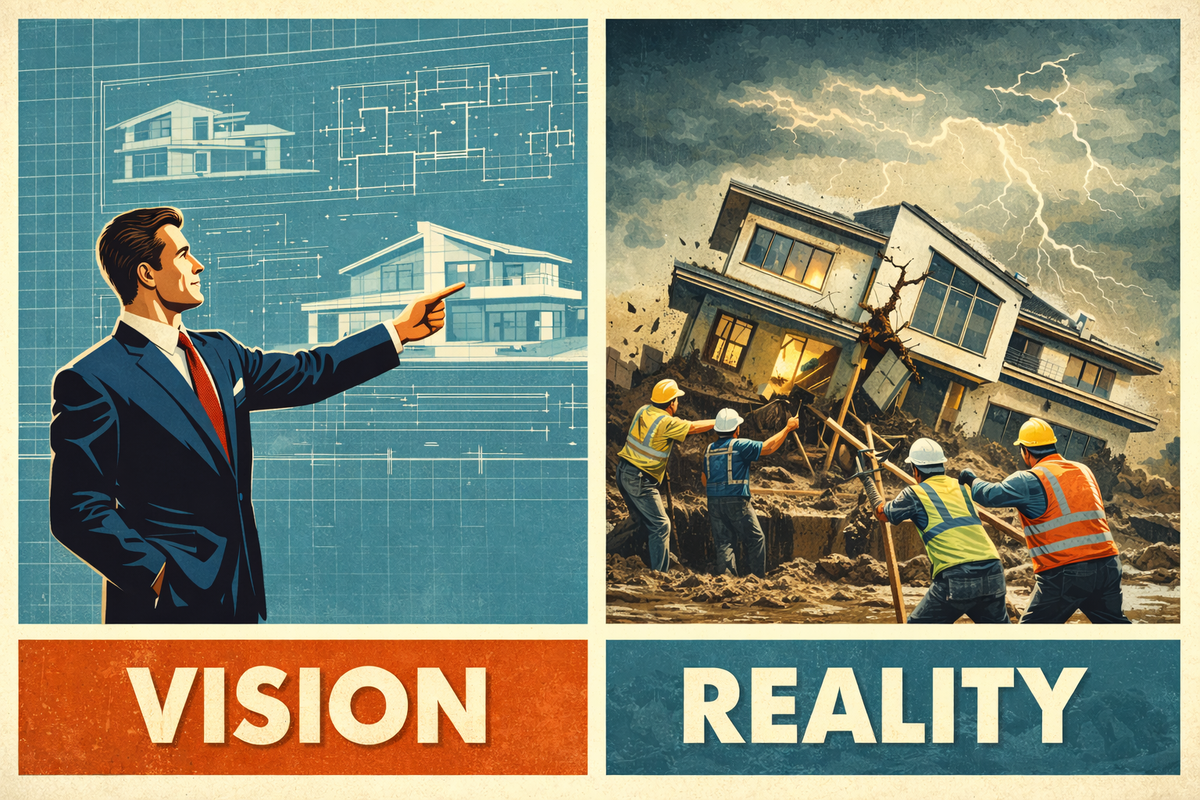
Picture an architect drawing a beautiful house. Every detail is there. Soaring ceilings. Expansive windows. Elegant lines. The vision is perfect. You can see it. You can almost walk through it.
The contractor looks at the drawings and asks a simple question. "Where's the foundation?"
"We'll figure that out later," the architect says. "I need to see the house first."
The contractor knows something the architect hasn't learned yet. You can't build a house without a foundation. Not later. Not eventually. Not after you see what the house looks like. Foundation first, always. Otherwise the house falls.
This conversation happens every day. Boardrooms. Startup offices. Strategy meetings. The founder has perfect vision. They can see exactly where they want to be. The architecture is crystal clear in their mind.
Then the operator says "we need to build A through W first." And the founder rejects it. Too slow. Too cautious. Too much process. They want to jump straight to XYZ because that's where the vision lives.
Vision alone isn't leadership.
The architect sees the destination. The contractor knows the path. Leadership is having the humility to listen when the contractor says foundation comes before house. When the operator says A comes before XYZ. When the smart person you hired tells you what actually needs to happen.
Even the Greats Had to Learn This
The greatest founders didn't start with this wisdom. They learned it. Usually painfully. Usually after spectacular failures that came from confusing vision with leadership.
Reed Hastings: The $12 Billion Lesson
Reed Hastings had perfect vision in 2011. Streaming was the future. DVDs were dying. Netflix needed to separate the businesses to move fast without being anchored to obsolete technology.
The vision was correct. The strategy was sound. The architecture was beautiful.
But when smart people on his team said "customers will hate this," Hastings didn't listen. He was the architect. He could see the future clearly. Why would he listen to people who couldn't see what he saw?
Qwikster launched in September 2011. By October, Netflix had lost $12 billion in market value and 800,000 subscribers.
Here's what separates good founders from great ones. Humility.
Hastings didn't blame the market. He didn't blame customers for not understanding his vision. He publicly admitted it. "I messed up. I owe everyone an explanation."
He reversed the decision. He rebuilt Netflix's culture around listening to operators who know the path. "Highly aligned, loosely coupled." Trust smart people to tell you HOW to execute your vision, even when it conflicts with what you think should happen.
That humility is what made Netflix dominant. Not the vision. The humility.
Steve Jobs: From Screaming to Listening
Early Steve Jobs was famous for screaming at people. He had vision, intensity, and absolute conviction that his architectural drawings were perfect. If people couldn't execute his vision, the problem was them.
He drove people out of Apple. He got fired from his own company.
Jobs came back different. Older. Humbled by failure. And he said something that defined his second act. "It doesn't make sense to hire smart people and then tell them what to do. We hire smart people so they can tell us what to do."
That's not weakness. That's understanding the architect needs the contractor. Vision needs operators who know the sequence, the prerequisites, the foundation that makes beautiful architecture possible.
Jeff Bezos: Building a Culture of Listening
Early Amazon Bezos was notorious for being the smartest person in every room. He made every decision. He out thought everyone. He was the architect. Everyone else was there to execute his drawings.
That works at a certain scale. It stops working when the company grows beyond what one person can architect completely.
Bezos built "disagree and commit" into Amazon's culture. Not because he had less vision. Because he learned that leaders are right a lot when they listen and change their minds. Not when they force their vision through despite objections.
The Pattern
Hastings. Jobs. Bezos. Different personalities. Different companies. Different failures. Same lesson.
Vision shows you the destination. Leadership is listening to people who know how to get there.
They all started thinking vision plus intensity equals success. Work harder. Move faster. Want it more. You'll get there.
They all learned the formula isn't vision, then hard work, then success. The formula is vision, then leadership through listening to operators, then proper sequence, then success.
Skip leadership and fill that gap with magical thinking? All your hard work is just falling without a parachute while calling it decisiveness.
When You Need This Most
Here's the timing trap. Founders think the transition from doing everything themselves to listening to operators happens when they're "big enough."
It doesn't. It happens the moment you have traction.
The instant customers want what you're building. The moment investors show interest. When the idea stops being theoretical and starts being real.
Not years down the road when you're drowning. Not when you're preparing for Series A and discover your books are held together with spreadsheet notes. Not when due diligence reveals you've been building houses in midair.
The moment you have traction.
Joseph Didn't Wait
In the Gospel of Matthew, Joseph had clear vision. He needed to protect his family. But vision alone wasn't enough.
He received guidance in a dream. Herod is coming. The child is in danger. Flee to Egypt.
Joseph could have rejected the guidance. "I have vision. I can see we need to be safe. I'll just work harder at staying hidden."
That would be vision without leadership. Vision filled with magical thinking that effort overcomes reality.
Instead, Joseph listened. That night, he acted. Not years later. Not "when we have more resources." Immediately. He left everything. Disrupted all plans. Fled to Egypt.
That action saved the Christ child and changed history.
Vision alone wouldn't have saved him. Magical thinking that working harder would protect them wouldn't have saved him. What saved everything was Joseph's humility to listen and his courage to act immediately.
The operator telling you "A-W come first" is your angel. The contractor saying "where's the foundation?" is your wisdom. The smart person you hired saying "this will fail without prerequisites" is your warning.
You can be like Joseph. Clear vision. Humble enough to listen. Courageous enough to act immediately.
Or you can reject the guidance and watch what you're building fail.
Joseph's humility to listen and act saved everything. Not the vision. The humility.
You can be like Joseph. Clear vision. Humble enough to listen. Courageous enough to act immediately.
Or you can reject the guidance and watch what you're building fail.
The window closes fast. Joseph acted that night. You don't have to wait for your own Qwikster moment. You don't have to get fired from your own company. You can learn it now.
What "Later" Actually Looks Like
Here's what happens when founders ignore the operator and jump to their vision without building the foundation.
The spreadsheet starts simple. Month one, someone moves money and makes a note. Feels productive. Fast. Easy. Month three, dozens of entries in different formats by different people. Month six, hundreds of transactions across multiple contradictory versions. Nobody knows which spreadsheet is current. Nobody remembers what half the notes mean.
Month twelve, investors want clean financials. Now you're trying to reconstruct a year of inter company transactions from notes that made sense to people who no longer work there. The notes don't match the transactions. The transactions don't match the accounts. The accounts don't match reality. You hire someone to untangle it. They quit after two weeks.
Month eighteen, you're in due diligence. The house is tilting. Cracks are appearing. And there's no foundation to catch it when it falls.
Later arrived. It brought accountants, auditors, investors, and an impossible mess. The house fell. Magical thinking about working harder didn't slow the collapse.
Vision Needs Operators to Become Real
You cannot scale without operators. You cannot build a house without contractors. You cannot convert architecture into buildings without people who know how things actually get built.
Maybe in the very beginning, vision is enough. You're the architect and the contractor. That's appropriate when you're building a shed.
But the moment you have traction? You need operators. And you need to actually listen to them.
Not hire them to execute your vision exactly as you see it. Hire them to tell you what needs to happen. Listen when they say A comes before XYZ. Trust them when they say foundation before house.
Vision gets you started. Operators make it scalable. Leadership is having the humility to listen.
It's like having a four cylinder engine in a plane, purposefully disabling three cylinders, then wondering why you didn't have enough power to get off the ground and crashed into the trees at the end of the runway. It wasn't because the plane couldn't fly. It was because you refused to let all the cylinders run.
In Ready, Fire, Aim, Michael Masterson warns that entrepreneurs often become the very thing that limits their company's growth by refusing to delegate. In The Goal, Eliyahu Goldratt shows how a bottleneck throttles the throughput of the entire system. Put them together and you see it clearly. The founder who won't listen to operators, who insists on making every decision, who hoards control. That founder is the bottleneck. Not the market. Not the team. It's the founder refusing to let all the cylinders run.
And here's the timing trap. You think you can wait until you're "big enough" to make this transition. You can't. By the time you're "big enough," you've already built all the wrong systems. Poured mud where concrete should be. Now you're trying to retrofit a foundation under an existing house.
The transition needs to happen the instant the idea gets legs.
If You're Already Falling
Maybe you're reading this and recognizing yourself. You've already built the house without a foundation. The mess is real. The house is sinking.
Or maybe you're at the beginning. The idea has traction. You're about to make the choice that determines everything that comes next.
Either way, you have two options.
Keep defending the decision. Double down on magical thinking. Watch the house burn to the ground.
Or, show humility, listen to operators, pour concrete instead of mud, and build something that holds the weight.
It's never too late. Hastings was losing $12 billion before he admitted it was wrong, reversed publicly, and rebuilt Netflix's culture around listening. That humility, not the vision, made Netflix dominant.
Jobs was fired from his own company before he came back humbled and rebuilt Apple around "hire smart people to tell us what to do."
Joseph acted immediately when he received the warning. That night. Not years later. That action saved the Christ child and changed history.
You can do the same. Too many founders say "I know better than everyone, I wish people would just listen to me." That's the fastest path to failure. The smartest thing you can do is hire operators smarter than you, try to be the least smart person in the room, then actually listen to them and get out of their way.
Act now. Everything you're building depends on it.