The Physics of Scale: Why What Got You Here Will Break You At Scale
Startup behaviors that drive early growth often break at scale. Risk compounds exponentially while your margin for error shrinks to zero. Understanding the physics of business growth and organizational transformation helps founders navigate this critical transition.

It's 8pm on a Thursday and you're staring at tomorrow's calendar. Eleven meetings, all of them necessary, none of them sufficient. Your inbox has 847 unread messages. Three departments are waiting on decisions only you can make. You remember when this felt good, when being the person everyone came to meant you were building something real.
Now it just means you're drowning.
Here's what nobody tells you: you're not drowning because you're doing it wrong. You're drowning because you're still doing what worked at 20 people. The physics changed. You didn't.
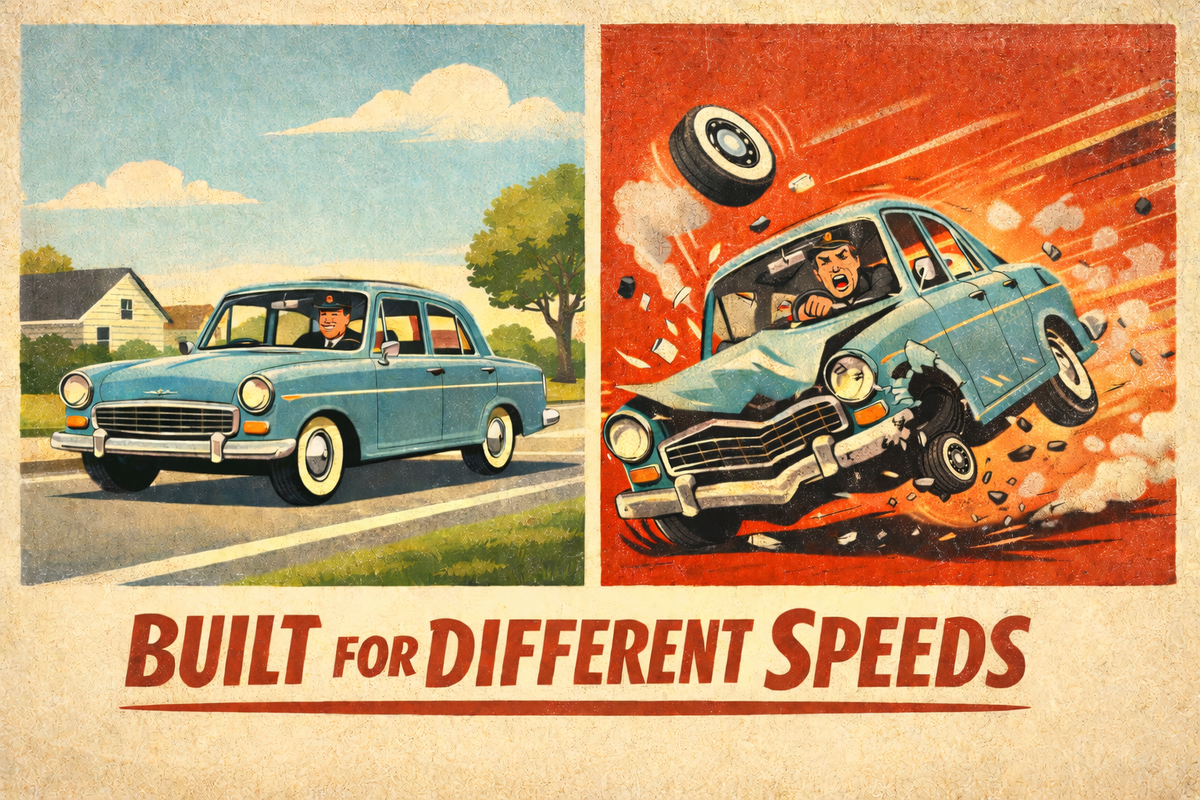
Think of it this way. A regular passenger car runs beautifully at 65mph. Stable, reliable, gets you where you need to go. Try to push that same car to 200mph and the wheels fall off. Not because it's a bad car, but because it wasn't engineered for those forces. An F1 racing car at 200mph is designed for it. Different suspension, different aerodynamics, different everything. It looks like a car, but it's a fundamentally different machine built for fundamentally different forces.
You're not running the same business at different sizes. You're running two fundamentally different organisms that happen to share a name. What worked for the micro version, the startup scrapping its way to survival, will kill the macro version. Not because you became weak or corporate, but because the physics changed.
The Transformation You Didn't Notice
At 10 people, you were a single-celled organism. Fast, adaptable, able to pivot on instinct. All functions happened in proximity. Context lived in conversations. You touched everything because you had to, and it worked.
At 100 people, you're a multi-system organism. Specialized functions, distributed operations, coordination overhead. You can't touch everything anymore, but you're trying to anyway because that's what got you here. Each step from 10 to 100 felt like more of what was working. More customers, more revenue, more people doing the thing that worked.
What you didn't notice: somewhere in that climb, the margins compressed. The room for error shrank. The cost of mistakes compounded. You kept operating with startup instincts in an environment that no longer tolerates them.
The same behaviors that ensured survival at startup now threaten your existence at scale.
The Physics: Risk Scales Exponentially
Here's the law: as your business scales, risk doesn't just grow, it scales exponentially. At the same time, your margin for error shrinks to nearly zero.
At startup scale, you have room for error. You try things, learn fast, pivot quickly. A wrong decision affects 50 customers and you can personally make it right. A bad hire costs $60K and you notice within weeks. You can ship something broken and fix it fast. Missing a communication means a few people are misaligned for a few days. The cost of being wrong is manageable. You get multiple attempts.
At enterprise scale, you don't get to respawn.
That same wrong decision now affects 50,000 customers. Brand damage. Regulatory scrutiny. Quarters to recover. That bad hire? They hire ten more bad hires. Cultural rot sets in. Years and millions to fix. Breaking things compounds. You can't ship new features while competitors gain ground. Missed communication? Entire divisions operate on conflicting strategies. Months of wasted work.
The behavior didn't change. The consequences did.
What This Actually Looks Like
When you centralize all decision-making at 20 people, it gives you speed and coherence. You're the person with the context, you make the call, everyone moves. At 100 people, you're the bottleneck. Decisions queue up waiting for you. You can't possibly absorb all the context anymore, so you're making calls with 20% of the information you used to have. Quality degrades. Speed collapses. Your best people start routing around you or just waiting, and both options create drift.
The rapid experimentation that got you here worked because the cost of being wrong was contained. You could ship something broken, learn from it, fix it fast. At scale, breaking things compounds. What used to take an afternoon to fix now requires quarters to unwind.
Informal communication feels efficient when everyone's in one room. "We all just talk" means low overhead, natural alignment, fast decisions. At scale, informal communication means different departments operating on different assumptions because there's no systematic way to know what anyone else knows. You find out months later that two teams built incompatible solutions to the same problem. The rework costs more than the original work.
Hiring people you know and trust matters early. You need cultural fit, shared values, people who can wear multiple hats. At scale, hiring from your network creates homogeneity, capability gaps, and "who you know" politics. One mediocre hire at startup is a contained problem. One mediocre hire at scale hires more mediocre people, shapes culture, becomes politically unfireable. The organizational drag compounds for years.
Your ability to personally hold context worked when the context fit in one brain. You could narrate the why behind decisions, share the history, explain the tradeoffs. At scale, no brain is big enough. You become the bottleneck not because you're slow, but because transferring your context is bandwidth-constrained. People make decisions without context, or they wait for you, or they guess. All three options create misalignment that costs you speed, quality, and money.
Margins Compressed
You'd think getting bigger means having more resources, more buffer, more room to absorb shocks. The opposite is true.
At startup, you have infinite lives. You can pivot the product, fire and rehire the team, renegotiate with creditors, rebrand after a disaster. The startup graveyard is full of founders who failed three times before they succeeded. That's celebrated.
At scale, you get one life. Maybe.
Because now thousands of employees depend on you for their livelihood. Customers have integrated your product into their operations. Banks have covenants tied to your performance. Regulators are monitoring your compliance. Your brand took years to build and can crater in days.
When you fail at scale, you don't just lose, you take everyone down with you. Lawsuits from investors, employees, customers. Personal liability. Reputation damage that follows you for years. You don't get to "start over." You get consequences that compound.
The same risk tolerance that enabled startup success becomes organizational suicide at scale. Missing payroll once at startup is painful but survivable. You explain, people stay, you recover. Missing payroll at scale means lawsuits, talent exodus, reputation destroyed. One terrible quarter at startup means you tighten up and push harder. One terrible quarter at scale means analyst downgrades, board panic, layoffs, death spirals.
The margins compressed while you were focused on growth. What used to be recoverable mistakes are now catastrophic failures.
Why This Is Invisible
The transition is invisible because each individual step feels like more of what's working. You're growing. Revenue is up. Customers are buying. Investors are happy. From the outside, this looks like winning.
But inside, you're working 70-hour weeks. You can't take vacation without everything slowing down. You're making decisions with a fraction of the context you used to have. Your best people are frustrated because they can't move without you. Critical functions are falling through cracks because role clarity dissolved somewhere between 30 and 80 people.
The muscle memory is deep. The identity is wrapped up in how you do things. "We move fast." "We're scrappy." "We don't need bureaucracy." These were virtues at startup. At scale, they're vulnerabilities.
There's no alarm bell that goes off and says "the stakes changed." No clean line where the operating system has to flip. You're in the messy middle, trying to figure out which startup behaviors to keep and which have become liabilities, while the business keeps running and everyone's watching to see if you can navigate this.
The Emotional Reality
If you're reading this and recognizing yourself, you might also be feeling something else beneath the exhaustion. Because what this really means is: you have to unlearn what made you successful.
Being the hub felt good. Being needed, being the person with the answers, being the reason things moved. That was proof you were building something real. Now you have to choose to be less central, and that feels like loss. Like diminishment. Like maybe if they don't need you for everything, they don't need you at all.
The fear isn't irrational. Things might go wrong when you're not the hub. Decisions might be made that you disagree with. Quality might slip. The instinct to swoop back in is overwhelming.
But here's what's also true: the structure that got you here is designed to collapse at this weight. The wobble you're feeling isn't weakness. It's physics telling you it's time to rebuild. Not because you're failing, but because you succeeded past the capacity of your original structure.
This transition doesn't happen in one decision or one org chart revision. It happens in dozens of small moments where you choose to operate differently than your instinct tells you to. Those moments are hard. We'll explore that emotional terrain in depth in a companion piece. For now, know this: the discomfort isn't a sign you're doing it wrong. It's the signal that you're ready for the transformation.
What Comes Next
You can't operate at macro scale with micro operating systems. Different organism, different physics. The behaviors that ensured startup survival (centralized decisions, informal communication, rapid experimentation, you as the context) have to transform into something else. Distributed decision-making through transparent systems. Formalized critical communication. Strategic execution with precision. Context held in accessible structures, not in your brain.
This isn't about becoming corporate or bureaucratic. It's about rebuilding your load-bearing architecture for the weight you're now carrying. The rapid feedback loops that taught you at startup don't exist at scale. You need systems that prevent problems rather than just detecting them faster.
The stakes changed whether you wanted them to or not. You don't get to respawn anymore. You can keep being the hub until the structure collapses, or you can rebuild now while you still have stability.
The choice is physics, not preference. And the wobble you're feeling is your invitation to begin.
In future pieces, we'll explore how transparency becomes the operating system for distributed context, how to navigate the emotional journey of scaling yourself out of the center, and how transformation happens in 90-minute windows of choosing differently. But first, you have to see the pattern. You have to recognize that what got you here won't get you there. And that's not failure. That's physics.