The Geometry of Thought
"If you know the radius of a person's knowledge, you know the circumference of their thoughts." ~Dr. Drake Dudley

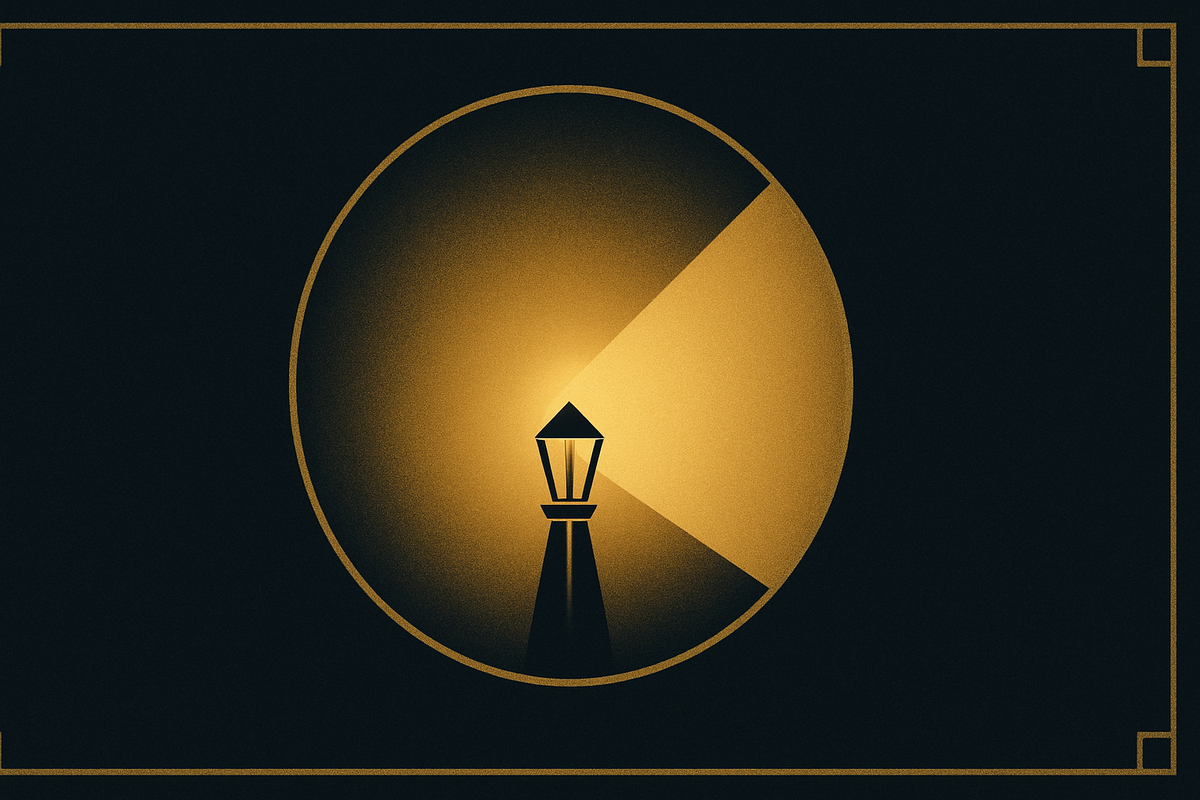
My friend Dr. Drake Dudley recently said something in conversation that stopped me completely: "If you know the radius of a person's knowledge, you know the circumference of their thoughts."
It hit like those rare statements that feel true before you fully understand why. But the more I sat with it, the more I realized he wasn't offering insight or metaphor. He was stating a law. A metaphysical law about how thought itself actually works.
Think about the geometry. If your knowledge forms a radius from center to edge, then the circumference (that outer boundary where you encounter new ideas) is mathematically determined by how far that radius extends. Small radius, small circumference. Limited knowledge, limited range of possible thought.
But here's what makes it a law rather than just an observation: you cannot think beyond that circumference. Not "it's difficult to think beyond it" or "most people don't think beyond it." You literally cannot. Your thoughts are constrained by the boundary that your knowledge creates. The edge of what you know determines the edge of what you can think.
This isn't limitation. It's architecture. It's how thinking works.
Call it Drake's Law: your thoughts are bounded by your knowledge. Always.
You've heard that a fish doesn't know it's wet. But the real insight goes deeper: the fish cannot imagine walking on dry land. That concept exists completely outside its knowledge radius, which means it's outside the circumference of thoughts the fish is capable of having. Not "unlikely to think about." Impossible to think about.
Here's a simpler example: before you ever tasted lemon on fish, the thought "this needs lemon" couldn't occur to you. Not because you lacked creativity, but because lemon as a solution didn't exist in your knowledge radius. The first time you tasted it, your circumference expanded. That thought became possible. Same brain, larger circle.
This is how the mind protects itself and simultaneously limits itself. Your brain operates on pattern recognition and cognitive efficiency. It takes what you already know and uses those patterns to interpret everything new. Unknown territory beyond your current knowledge base registers not as opportunity but as potential threat. The unfamiliar requires more cognitive resources, creates uncertainty, demands energy your brain would rather conserve. So it defaults to the known, the comfortable, the already-mapped territory of your existing circumference. This efficiency keeps you safe. It also keeps you small.
The Radius Principle
Napoleon Hill understood Drake's Law completely. "Think and Grow Rich" isn't about positive thinking or willing wealth into existence. Read the actual book and you'll find Hill prescribing the same principle: expand your knowledge radius through deliberate study, specialized knowledge, and what he called the mastermind principle.
The mastermind isn't networking for deals. It's systematic radius expansion. You surround yourself with people whose knowledge extends beyond yours, and through that association, you gain access to thoughts you couldn't think alone. You're borrowing their circumference until your own radius catches up.
There's a modern phrase that captures this: "Your network is your net worth." Most people hear that as transactional advice about collecting contacts. But the real truth runs deeper. Your network IS your accessible knowledge radius. Each person carries knowledge you don't have. When you can genuinely tap into their expertise, their experience, their perspective, you're expanding the circumference of thoughts available to you.
Your network determines your net worth because it determines how large a knowledge radius you can access, which determines what thoughts become possible, which determines what solutions you can conceive, which determines the value you can create.
Hill knew this. The problem is people read the title and miss the instruction.
The Comfortable Circle
Here's what actually limits us: we stop seeking knowledge at the edge of our current circumference. Not because we've learned everything, but because we've learned enough to feel comfortable. The circle becomes familiar. We know how to navigate it. Expanding feels risky, unnecessary, or simply exhausting.
There's a psychological reason this happens. Your sense of self is built on what you know and how you've learned to see the world. New knowledge doesn't just add information. It threatens identity. When you encounter ideas that challenge your existing framework, your brain experiences it as destabilization. Cognitive dissonance creates actual psychological discomfort. So you avoid it. You dismiss perspectives that don't fit. You stay in environments that confirm what you already believe. You surround yourself with people who share your circumference. This isn't weakness. It's your mind protecting the coherent story it's built about who you are and how the world works.
But here's what that costs: you can't think your way to better relationships without knowledge about attachment, communication, how people actually connect. You can't process complex emotions without the vocabulary for them. You can't take perspectives you've never encountered. You can't ask questions about things you don't know exist.
The Apostle Paul understood this when he wrote about becoming "all things to all men." Most people read that as people-pleasing or losing yourself to accommodate others. But Paul was describing something far more demanding: expand your knowledge radius until your circumference overlaps with different people's circumferences. Learn enough that the thoughts available to them become available to you. Not by pretending, but by growing your knowledge base so large that you can genuinely think within their framework because those thoughts now exist within your own circle of what's possible.
To the Greeks, become Greek. To the Jews, become Jewish. That requires your circumference to stretch far enough to encompass their thought patterns, their perspectives, their ways of seeing. It's the opposite of self-limitation. It's radius expansion so extensive that your circle of possible thoughts intersects with many different circles.
Outside Your Circumference
The corners you cut aren't in business plans. They're in relationships. The conversation you avoid because you don't have language for what you're feeling. The pattern you can't see in your behavior because you've never learned that pattern has a name. The perspective you dismiss as irrelevant because it uses concepts outside your circumference.
Consider emotional vocabulary. If you've never learned words for complex emotional states, you can't think nuanced thoughts about what you're experiencing. You feel something uncomfortable and label it "bad" or "stressed" because those are the only categories in your radius. Someone with richer emotional vocabulary experiences the same internal state but can identify it as shame, or grief, or fear of vulnerability. Same feeling, completely different circumference of thoughts about what to do with it. In extreme cases, this limitation has a name: alexithymia. The inability to identify and describe emotions. But most of us live with a milder version. We simply don't have enough knowledge about our inner lives to think clearly about them.
The same principle applies to relationship patterns. You can't recognize your anxious attachment style if you've never learned attachment theory exists. You'll just think you're "needy" or your partners are "distant." You'll repeat the same relationship dynamics over and over, wondering why nothing changes. The pattern is running perfectly. You just can't see it because the framework to understand it doesn't exist in your knowledge radius. Therapy works partly by introducing new frameworks that make previously invisible patterns suddenly thinkable.
And when someone tries to help (a friend, a therapist, a partner pointing at something they can see that you can't) their words often land as noise. They're describing territory outside your knowledge radius, using concepts that don't exist in your current circle of possible thoughts.
Here's the psychology of why you can't hear them: your brain uses cognitive schemas, mental frameworks that filter all incoming information. These schemas determine what you notice and what you ignore, what makes sense and what sounds like nonsense. When someone describes a pattern or dynamic using concepts outside your schema, your brain literally filters it out as irrelevant. You hear them talking, but you can't actually receive what they're saying because receiving it would require thoughts you're not capable of having yet. It's not stubbornness. It's not denial. It's the fundamental architecture of how minds process information.
This is the cruelest part of Drake's Law. The help you need most is the help you're least equipped to recognize. The knowledge that would expand your radius most dramatically is the knowledge that seems most irrelevant from inside your current circle.
The fish doesn't know it's wet and can't imagine dry land. At least the fish has an excuse. It can't exactly swim to the library.
We can. And mostly we don't.
Expanding the Edge
Drake's insight wasn't a suggestion. It was a statement of how reality works: if you know the radius of a person's knowledge, you know the circumference of their thoughts.
That's not limitation. That's architecture. Drake's Law doesn't care whether you accept it. It operates regardless.
But here's what the law also means: the circumference you have right now isn't permanent. It's just where you stopped learning.
When you learn something genuinely new, something that expands your radius rather than just adding detail to your existing circle, your brain physically changes. Neuroplasticity means new knowledge creates new neural pathways. Thoughts that were literally impossible before become possible because the brain structure to support them now exists. This isn't metaphor. Learning changes what you can think at a biological level.
Every book you don't read, every conversation you avoid, every perspective you dismiss, every piece of knowledge you decide you don't need: that's you choosing your current boundary. You're not limited by what you don't know. You're limited by what you refuse to learn.
The fish can't imagine dry land because it has no access to that knowledge. You can't imagine solutions, perspectives, or ways of being that exist outside your current radius. But unlike the fish, you can expand that radius. You can seek knowledge that makes new thoughts possible.
The question isn't whether Drake's Law is fair or convenient. The question is: what knowledge are you refusing to seek because it would require you to expand beyond your comfortable circle?
Your thoughts are bounded by your knowledge. That's the law.
The only question is: what will you learn next?