The Four P's
In 1960, E. Jerome McCarthy gave the business world the four P's of marketing. Someone else gave us People, Process, Profit. Neither framework was wrong. But both were incomplete, and neither one got the diagram right.

In 1960, a marketing professor named E. Jerome McCarthy gave the business world a framework it never stopped repeating: Product, Price, Place, Promotion. The four P's of marketing. A clean, teachable model for how you bring something to market.
It worked. So well that the P's became a template. If you needed to organize a business idea, you reached for alliteration and a short list. The format outlived the original content.
Which is how we ended up with People, Process, Profit. The operational three P's. A different framework, same borrowed architecture, and for a generation of managers and consultants, the definitive answer to how a business runs.
I had a conversation recently with a friend who has spent years inside that framework. He's sharp, experienced, and he's made decisions that worked. His conclusion: process and profit have to come before people. Build the machine first, then hire to run it. He's not wrong, exactly. I've watched enough organizations collapse from the opposite failure, building on relationships before building a foundation, to know there's something real in what he's saying.
But I couldn't let it go. Because something is missing from both frameworks. Actually, two things.
The P Everyone Left Out
Masterson's Ready, Fire, Aim makes an argument I've never been able to shake: most businesses die before they ever get to process or people or profit. They die because they never had a product anyone would actually buy.
Not a product they believed in. Not a product they were proud of. A product the market would pay for. Those are not the same thing.
Founders build operations around untested ideas. They hire teams to support a product that hasn't earned the right to exist yet. They design process for something the market hasn't confirmed. Then they wonder why the machine doesn't generate profit.
You cannot process your way to viability. You cannot hire your way to product-market fit. Without something worth building, the other three P's have nothing to serve.
Start with Product. Get something people will buy. Prove it. Then build around it.
That gives us four P's. But the framework still isn't right, because of how we've been stacking them.
The Foundation Nobody Draws
Every version of the P's I've ever seen treats them as a sequence. A flow. Step one leads to step two leads to step three, like checkboxes.
The problem with a sequence is what it does to the things at the beginning. Once People start the process, they've served their function. They become inputs. Interchangeable parts. You optimize the machine, and the people inside it become components of the optimization.
I've watched this happen. Organizations with elegant process, clean reporting structures, and zero slack in the system. Everything running exactly as designed. And underneath it, people who stopped caring, stopped innovating, and stopped telling anyone when something was wrong. The machine was perfect. It just wasn't producing anything worth having.
Here is what I believe after thirty years of watching how things actually work:
People are not the first step in the sequence. They are the foundation the entire structure stands on.
Product, Process, Profit sit on top, in that order. But none of them function without the right people holding them up. The foundation doesn't show up in the org chart or the flow diagram. But remove it, or get it wrong, and everything above it eventually fails. Not always loudly. Sometimes slowly, quietly, in ways that look like market problems or strategy problems or timing problems, until you look underneath and find a people problem that was there from the beginning.
Perfect process with the wrong people is well-organized failure. Perfect process with the right people is unstoppable, and the profit follows.
What This Changes
If People are a step in a sequence, you hire for the role. You define the function and find someone to fill it.
If People are the foundation, you hire differently. You ask not just whether someone can execute the process, but whether they can hold the weight of what you're building. Whether their values, judgment, and character are load-bearing.
You sequence decisions differently. You don't scale until the foundation is solid. You don't add process until you have a proven product. You don't chase profit until the process is sound. And underneath all of it, you never stop asking whether the people are right, because they determine everything that can stand on top of them.
Foundations require care that doesn't always feel urgent. Nobody is standing over you demanding that you pour concrete correctly. The consequences show up later, compounded, when the structure above starts to shift.
My friend isn't wrong that process and profit matter. He's built real things. But I think he overcorrected from a real failure: leading with people before proving the product. The answer isn't to move people down the priority list. The answer is to understand what they actually are.
They're not a priority. They're the ground you're building on.
The Framework, Redrawn
McCarthy gave us the four P's of marketing. Someone gave us the three P's of operations. Neither framework was wrong, exactly. They were describing different parts of the same building from different angles.
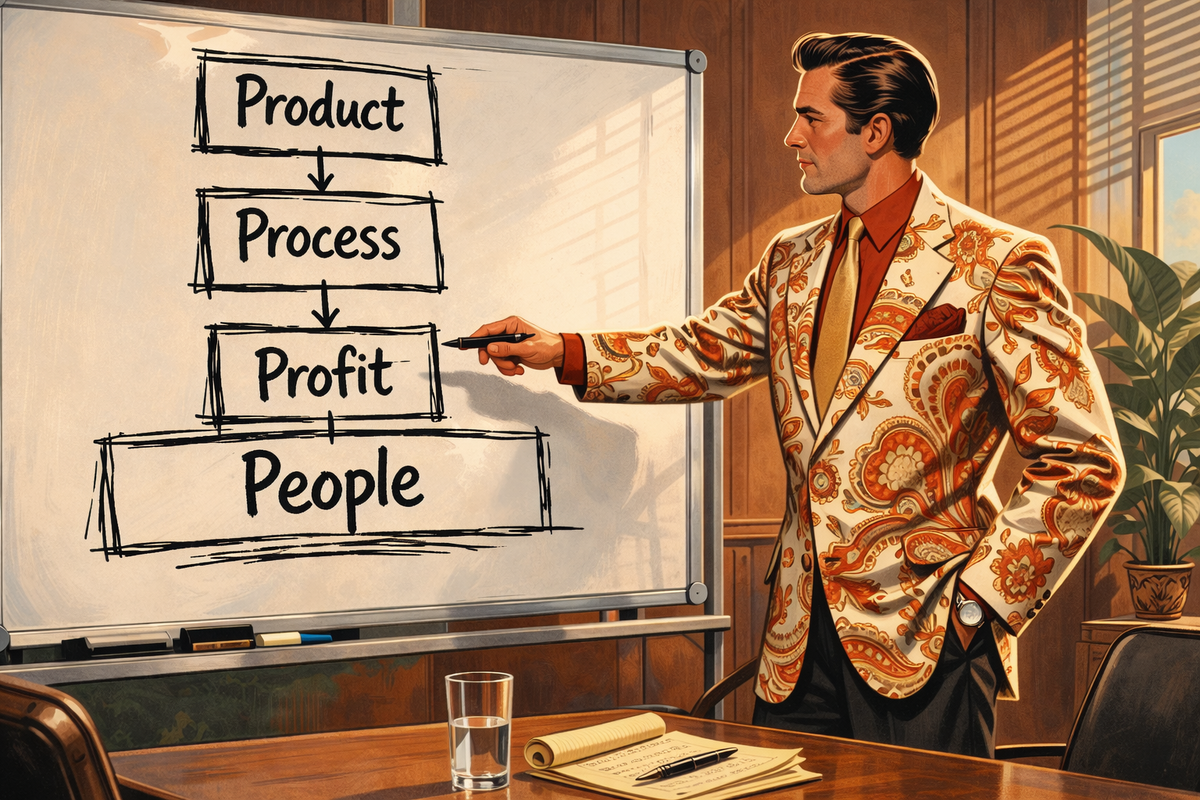
Here is how I'd draw it now:
At the foundation: People. Not first in the sequence. Beneath the sequence. Load-bearing, always.
On top of that foundation, in order: Product, then Process, then Profit.
Prove the product. Build the process to scale it. Let profit be the result of doing the first two things right, on a foundation of people who give a damn.
The P's aren't wrong. They just needed one more, and a better diagram.