The Cycle of Success
Wealth isn't built in the spotlight; it's built in the thousand invisible moments where you chose the harder right over the easier wrong. The Romans had three words for this: Fac quod dicis, which means do what you say. Jesus had it in one: Love. That's how you enter the cycle.
My understanding of success came to me in a quiet way, but the revelation changed my life.
It was early morning at the MasterWorks Festival. I was 17 and barely awake during our daily devotional. I wasn't really listening until Dr. Patrick Kavanaugh, the festival's founder, said these words: "What would our world look like if every day we got up and asked: How can I help those around me? How can I improve the world? What can I do?"
That question, in that moment, was like a bolt of lightning. It changed my entire perspective on life. It became my North Star, the guiding principle I've navigated by for more than three decades.
I can now tell you what success actually is: success is the freedom to do good. That's it. Everything else is just the mechanism by which you gain that freedom.
The Cycle, Not The Destination
Jesus told us 2000 years ago what success looks like when he said, "Love the Lord your God with all your heart and with all your soul and with all your mind. This is the first and greatest commandment. And the second is like it: Love your neighbor as yourself. All the Law and the Prophets hang on these two commandments." Everything hangs on these two commandments, and here's the truth most people miss: by doing the second, you do the first. When you love your neighbor, when you have integrity, when you do good, you are loving God.
Success isn't what you achieve; it's the cycle you enter. Integrity creates reputation, reputation creates opportunity, opportunity becomes wealth, and as scripture says, "to whom much is given, much is expected," which means wealth creates responsibility to do more good, which builds more integrity, and the cycle continues. This is success.
Most people think success is linear, that you work hard, get wealthy, and retire, but that's not success; that's quitting. Real success is cyclic, perpetuating itself so that the more you do good, the more capacity you have to do good. The ancient Chinese understood this. As Laozi wrote in the Dao De Jing: "The sage does not hoard. The more he does for others, the more he has. The more he gives to others, the more he receives." Money is meant to circulate, not be hoarded, so that wealth flowing through you to do good creates more wealth flowing back.
A very wise friend once told me that the path to wealth is finding something boring that nobody's thinking about and doing it really well. Here's what's boring: integrity, practiced every day, in small moments, when no one is watching. Here's what nobody's thinking about: that integrity is the cycle itself.
The Cost Is The Point
Integrity is doing the right thing when no one is watching and you could get away with doing the wrong thing. The invoice you correct when the error is in your favor. The credit you give when you could take it. The promise you keep when breaking it would be invisible. The truth you tell when the lie would work. Nobody sees these moments, nobody's grading you, nobody would ever know, and yet you do the right thing anyway, and it costs you.
That's the point: doing good costs us, and that's what breeds success. The cost is what makes it real, what separates integrity from convenience. Anyone can do good when it's free, but real integrity is doing good when it costs you something: your time, your money, your pride, your opportunity.
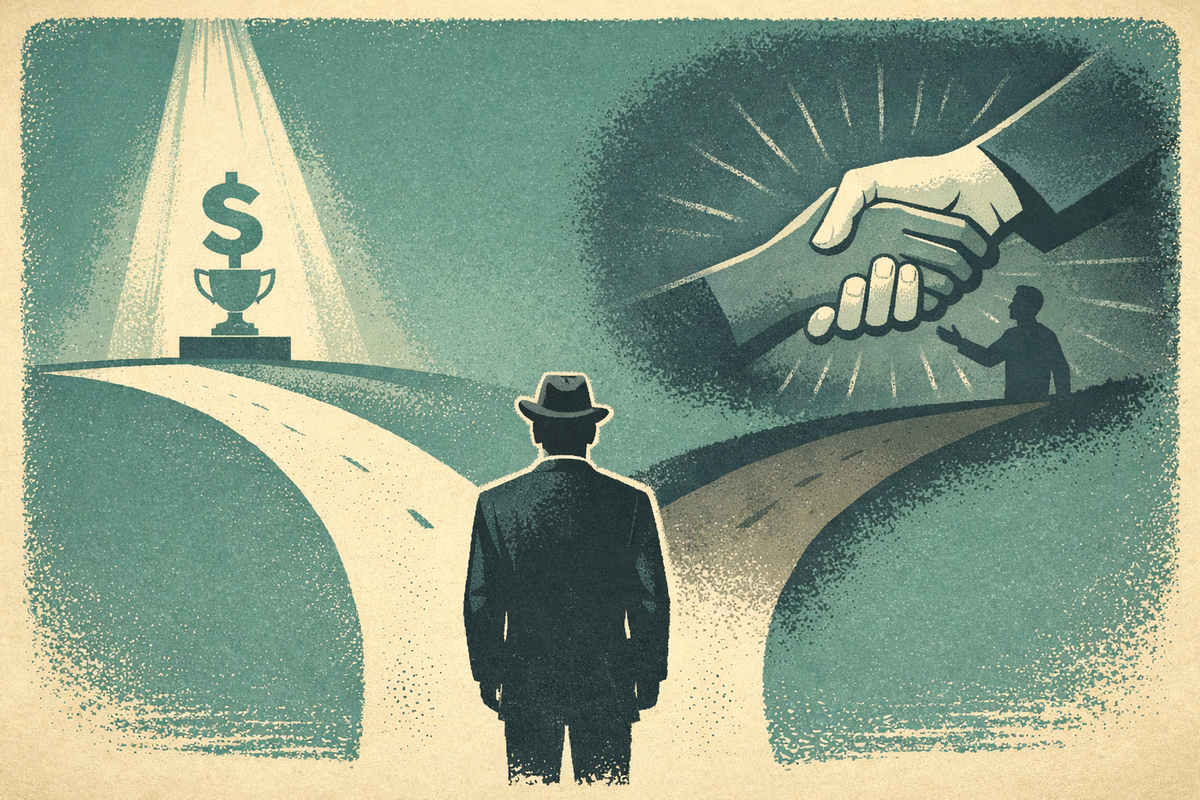
Wealth isn't built in the spotlight; it's built in the thousand invisible moments where you chose the harder right over the easier wrong. The Romans had three words for this: Fac quod dicis, which means do what you say. Jesus had it in one: Love. That's how you enter the cycle.
You don't have integrity so you can become successful someday. You have integrity, you pay the cost, and you enter the cycle of success right now, in the doing. And if you love your neighbor, if you do good, if you keep your word, wealth will follow, not as the goal, but as fuel for the next turn of the cycle. Each turn requires sacrifice, and each turn builds success.
The Way You Travel
Og Mandino understood this. Before writing one of history's most influential books, he was suicidal, alcoholic, at absolute bottom. He discovered that "love is the greatest secret of success in all ventures, for muscle can split a shield and even destroy a life, but only the unseen power of love can open the hearts of men." He spent the rest of his life circulating what saved him, giving it away to millions, and the wealth followed.
The cycle never stops. Success isn't arriving somewhere and being done; it's staying in the cycle, doing good when you have nothing and doing good when you have much. The way you travel is the cycle, and the cycle is success.
Act with urgency but never sacrifice integrity for speed. Fast but not sloppy, quick but not careless, urgent but not dishonest. Do the right thing, and do it now. "I will act now." Not tomorrow, not when it's convenient, but now, and do it right even when the easier path tempts you.
My Headstone
When I die, I want my headstone to read: Here lies a good man, a man who did good.
Not because of what I accumulated, but because of how I traveled. The small kindnesses. The kept promises. The integrity when no one was watching, when no one knew what it cost me. Because I did what I said I would.
That's the cycle. That's success.
The cycle of success: Do good (it costs you) → Build reputation → Create opportunity → Gain wealth → Accept responsibility → Do more good (it still costs you).
That's success: the cycle, the way you travel, the perpetual motion of doing good.