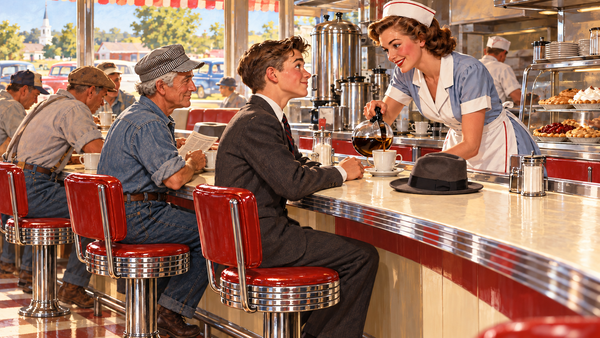
NO TWEEZERS ALLOWED
A twelve-seat diner in Tokyo, open from midnight to seven, remembers something much of the restaurant world has forgotten: what the word hospitality actually means, and who it was always meant for.

If I ever ran a fine dining kitchen, I would hang one sign above the pass, in letters big enough to read from the back door: NO TWEEZERS ALLOWED.
I mean that with a smile. I am not against fine dining. I understand the art behind it, the years of training, the obsession with balance, texture, and color. I have eaten meals that were genuinely beautiful, and art, like beauty, belongs to the one who sees it. A great tasting menu can move you the way a painting or a symphony can, and the people who make it deserve real respect.
But a plate built with tweezers is built to be admired. It asks something of you. It wants your attention, your wonder, your interpretation, and usually your phone. You are there to receive the chef's vision, and the evening is measured by how well that vision lands.
Hospitality works the other way around. It does not ask you to admire anything. It asks nothing at all. Its only measure is whether you leave more whole than you arrived.
What the Word Meant
The word hospitality comes from the Latin hospes. It is a strange and beautiful word, because it meant host, it meant guest, and sometimes it simply meant stranger. One word for everyone at the table.
It goes deeper than that. Hospes shares an ancient root with hostis, the Latin word for an enemy. The Greeks held the same tension in a single word, xenos, which could mean stranger, guest, or foreigner, depending on how he was received. The people who shaped these languages understood something we have forgotten. The stranger at your door could become your enemy or your guest, and the difference was you. Hospitality was the act that turned one into the other.
The same root gave us hospital, hostel, and host. Each one describes a place where someone who is not yours is taken in and cared for anyway. That was the original idea. You arrive as a stranger, and I treat you as though you belong. Nothing about it was meant to impress anyone.
Somewhere along the way, we let the word drift. Hospitality became a product, then a category, then a career measured in plating, ambiance, and online reviews. The guest slowly became an audience. The art took the name, and the older meaning went quiet.
It did not disappear, though. I found it again in a quiet Japanese series called Midnight Diner, at a small counter in Tokyo.
A Counter in Shinjuku
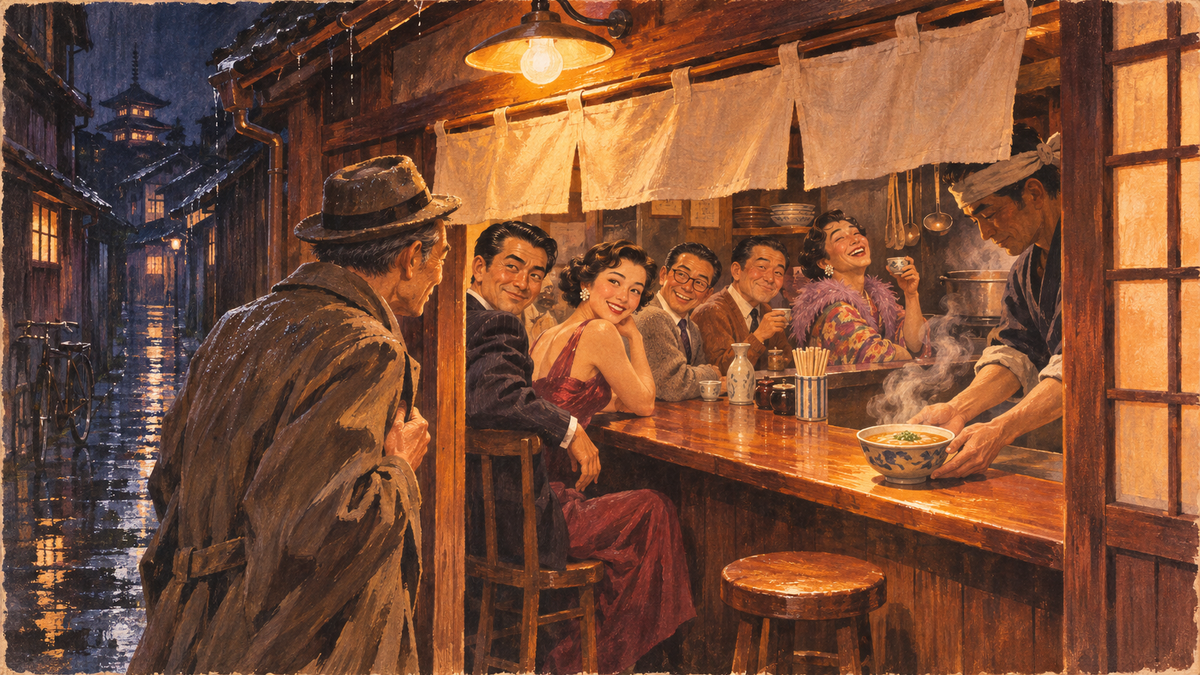
The show is set in a tiny diner with no name and just twelve seats, tucked into the back streets of Shinjuku, open from midnight until seven in the morning. Every episode opens with the Master's quiet narration as the camera drifts through the city: "When people finish their day and hurry home, my day starts." Out front, a single lamp glows above the door, and it stays lit all night, for whoever happens to need it. The menu lists one dish, a pork miso soup, along with beer, sake, and shochu. But the Master will make anything you ask for, as long as he has the ingredients.
That is the whole policy. Ask, and if he can, he will.
Nobody knows the Master's name or his history, yet every guest ends up sharing their own. He carries a scar across his face and never explains it. He smokes out back, wipes down the counter, and listens. That is most of what he does, and it is enough.
What strikes me most is his stillness. He does not hover. He does not perform. He listens far more than he speaks, and he almost never offers advice. When he does say something, it is usually one sentence, and it is usually the right one. His craft is as exacting as any tasting-menu kitchen, but it is pointed at the person, not the plate. Nothing is too small for his attention, and yet none of it looks like effort. That is what mastery looks like from the outside. The years of practice are invisible; only the care shows.
Every guest receives exactly what they need, in exactly the measure they need it. A bowl of rice with bonito flakes and a splash of soy sauce. A sweet rolled omelet. An egg sandwich shared between two young people who have just met. Red sausages cut to look like little octopuses, for a yakuza boss who has ordered them for years. The food is simple, but the food is never the whole meal. With every dish comes what the guest actually came for: comfort for the grieving, courage for the frightened, company for the lonely, and sometimes simply permission to rest. Nobody gets more than they need, and nobody leaves with less.
Then look at who gathers at that counter. A yakuza and a police detective. A stripper and a group of office workers. Kosuzu, a cross-dressing bar owner who brings joy everywhere. Lonely salarymen, struggling actors, young lovers, and old friends. In most of the world, these people would never share a table. Here they share a counter, a bottle, and sometimes a secret. No one is asked to explain themselves. No one is turned away because of who they are, what they believe, or whom they love. The arms of that little diner are open to everyone, and the Master treats each person with the same quiet respect.
Over time, the regulars learn to do it for each other. They make room for the newcomer. They cover a tab. They keep a confidence. The diner teaches its people what hospitality means, and how to live it.
One episode this season, about two men and a single carrot dish, carries all of this so completely that I will not describe it here. Go watch it. You will understand.
Why the First Bite Makes Us Cry
The first episode of the new season shows the regulars returning to the diner after the long isolation of the pandemic. Some of them had gone nearly a year or more without their favorite dish. When that first bite arrives, their faces change. Joy, relief, and something close to grief, all at once.
There is real science behind that moment. Most of what we call flavor is actually smell, rising from the back of the mouth as we chew. And smell is wired differently from our other senses. Sight, sound, and touch pass through a kind of relay station in the brain before they reach the rest of it. Smell travels almost directly to the parts that handle emotion and memory. That first bite reaches the heart before the mind has a chance to weigh in.
Researchers have found that memories triggered by smell tend to be older, often from childhood, and more emotional than memories triggered by words or pictures. Marcel Proust wrote about it more than a century ago, when a small cake dipped in tea returned his entire childhood to him. Psychologists still call it the Proust effect.
There is even research tying comfort food to belonging. In 2011, psychologists Jordan Troisi and Shira Gabriel published a study with a perfect title, "Chicken soup really is good for the soul: 'comfort food' fulfills the need to belong." People who ate chicken noodle soup, and thought of it as a comfort food, afterward reached more readily for words about relationships, words like include and welcome. As Troisi put it, "A lot of these foods serve as a reminder of relationships."
That is the Master's quiet power. When he sets down a bowl, he is doing more than feeding someone. Often, without a word, he is serving them a memory of the person who first made it for them, and for a few minutes, that person is at the counter too.
The Same Truth, Three Times
What moves me even more is how old this idea is, and how many people found it on their own.
In Japan it is called omotenashi, wholehearted hospitality, shaped by centuries of the tea ceremony. The host anticipates what the guest needs before it is spoken, and expects nothing in return. The tea tradition also gave the world a phrase I love: ichigo ichie, one time, one meeting. Every gathering happens once and will never happen the same way again, so it deserves your full attention. The Master lives that phrase every night. Japan has a strong sense of insiders and outsiders, which makes it all the more striking that its highest form of hospitality points outward.
In the Jewish tradition, welcoming guests is called hachnasat orchim, and it is treated as a commandment, not a courtesy. It begins with Abraham in Genesis, sitting at the door of his tent in the heat of the day, then running out to feed three strangers. He did not ask who they were. He simply fed them. The rabbis later taught that his tent was open on all four sides, so travelers could enter from any direction. And the Torah returns to the stranger again and again, with a reason that never grows old:
The stranger who dwells among you shall be to you as one born among you, and you shall love him as yourself; for you were strangers in the land of Egypt. ~ Leviticus 19:34 (NKJV)
Jesus brought that same truth to the table. He was criticized again and again for eating with tax collectors and sinners, the people no respectable person would share a meal with. He told one host that when he gave a feast, he should invite the poor, the maimed, the lame, and the blind, the guests who could never repay him. And when he described the final judgment, the measure was not status or success. It was whether we fed the hungry and took in the stranger.
For I was hungry and you gave Me food; I was thirsty and you gave Me drink; I was a stranger and you took Me in. ~ Matthew 25:35 (NKJV)
The early church carried it forward. The New Testament word for hospitality is philoxenia, which means, quite literally, love of the stranger. The writer of Hebrews reached all the way back to Abraham's tent to remind believers why it mattered:
Do not forget to entertain strangers, for by so doing some have unwittingly entertained angels. ~ Hebrews 13:2 (NKJV)
Three traditions, from very different parts of the world, arrived at the same place. The measure of hospitality is how you treat the person who is not yours.
Hospitality Is a Posture
Midnight Diner does not just show hospitality. It practices it.
The episodes are short. The pace is unhurried. The theme song is a single guitar and a quiet voice. Each story usually follows two people and one dish, and how they meet the food, the diner, the Master, and each other. When the story ends, the guests walk you through how to make the dish yourself, and the whole group cheerfully waves goodbye. The show never shouts, never rushes, and never asks you for anything. It takes you in at the end of a long day, gives you exactly what you need, and lets you go.
I come away from it as full as if I had been at that counter myself.
Hospitality is not a venue. It is not a restaurant, a hotel, or an industry. It is a posture, a way of making things for people. It can live in a kitchen or a lounge, an office or a living room, a fellowship hall or a twenty-four-minute television show. Wherever someone makes something with care, measures it for the person receiving it, and asks nothing back, hospitality is happening.
The tweezers are not really the problem. Neither is the white tablecloth or the twelve-course menu. The problem is the moment the maker's vision matters more than the guest's need. That can happen in a diner just as easily as a dining room. And the opposite can happen anywhere, too.
We Need More Counters
In 1989, the sociologist Ray Oldenburg gave a name to places like the Master's diner. In The Great Good Place, he called them third places: not home, not work, but the gathering spots in between. One of their defining traits, he wrote, is that they are levelers, places where a person's standing in society simply does not count. The yakuza and the detective, side by side at one counter, could not be a better picture of it.
Oldenburg believed that losing these places was wearing away our sense of community, and the years since have proven him right. In 2023, the U.S. Surgeon General declared loneliness a public health epidemic, reporting that even before the COVID-19 pandemic, about half of U.S. adults reported experiencing measurable levels of loneliness. The advisory warned that a lack of connection can raise the risk of early death about as much as smoking fifteen cigarettes a day.
We need those places back. More than that, we need people willing to keep them open. Midnight Diner works because one man keeps showing up, night after night, ready for whoever walks in. He does not ask for credit. He does not need to know your story. He only needs you to be hungry.
You do not need a restaurant to do this. You need a door you are willing to open and a table you are willing to share. You need to notice what someone needs and give them that, no more and no less. And you need to welcome the stranger as though they already belong, because in the oldest sense of the word, they do.
Put down the tweezers. Pull up a chair. Feed a stranger.