Know When to Fold: The Art of Strategic Surrender
Why the smartest form of persistence is knowing when to let go of what's not working.

"If you know the enemy and know yourself, you need not fear the result of a hundred battles. If you know yourself but not the enemy, for every victory gained you will also suffer a defeat. If you know neither the enemy nor yourself, you will succumb in every battle." ~Sun Tzu
Most people read this quote and immediately start thinking about their competition. They study market conditions, analyze their rivals, dissect what everyone else is doing. They focus entirely on knowing the enemy.
But Sun Tzu buried the real challenge in plain sight: knowing yourself.
That's the part that destroys most people. Not because self-knowledge is complicated, but because ego makes it nearly impossible. To truly know yourself, you have to admit when you're wrong. You have to recognize when your approach isn't working. You have to surrender strategies that aren't delivering results, even when you've invested everything in them.
Most people can't do this. Their ego won't let them.
So they keep pulling at ropes that will never break, calling it persistence. They keep running the same plays that keep failing, calling it determination. They confuse stubbornness with strength, repetition with commitment, and the inability to change with loyalty to their vision.
Here's the truth nobody wants to hear: "Never give up" is terrible advice when you're giving up the wrong things.
The Signature Move Problem
Picture a fighter who built their entire career on one devastating technique. Early on, it was unstoppable. Opponents didn't see it coming. Highlight reels featured it. Fans chanted for it. The move wasn't just what they did. It became who they were.
But the sport evolved. Opponents studied the tape. Defenses adapted. The move that once guaranteed victory started getting countered. Then blocked. Then turned against them.
Coaches suggest developing new techniques. "The game has changed," they say. "You need to evolve."
But here's what the coaches don't understand: asking this fighter to abandon their signature move isn't asking them to change their approach. It's asking them to stop being the person they've spent years becoming.
That move is their identity. Their brand. Their proof of who they are.
Surrendering it doesn't feel like smart strategy. It feels like erasing themselves.
So they don't adapt. They just try harder. They practice the move more. They look for better setups. They convince themselves that the move isn't the problem. Their execution is. The opponent's luck is. The referee's positioning is.
Anything except admitting that what made them successful is now what's holding them back.
This is what happens when ego fuses your identity with your methodology. You can't separate "this approach isn't working" from "I'm not good enough." You can't distinguish between surrendering a technique and surrendering yourself.
And that's when "never give up" stops being about persistence and starts being about ego protection.
The Persistence Trap
We've been sold a lie about persistence. The cultural narrative says successful people never quit, never surrender, never change course. They just keep pushing until they break through.
But that's not what actually happens.
Real success comes from people who are ruthlessly persistent about their goals while being completely flexible about their methods. They don't confuse the destination with the path. They don't mistake their current approach for their ultimate purpose.
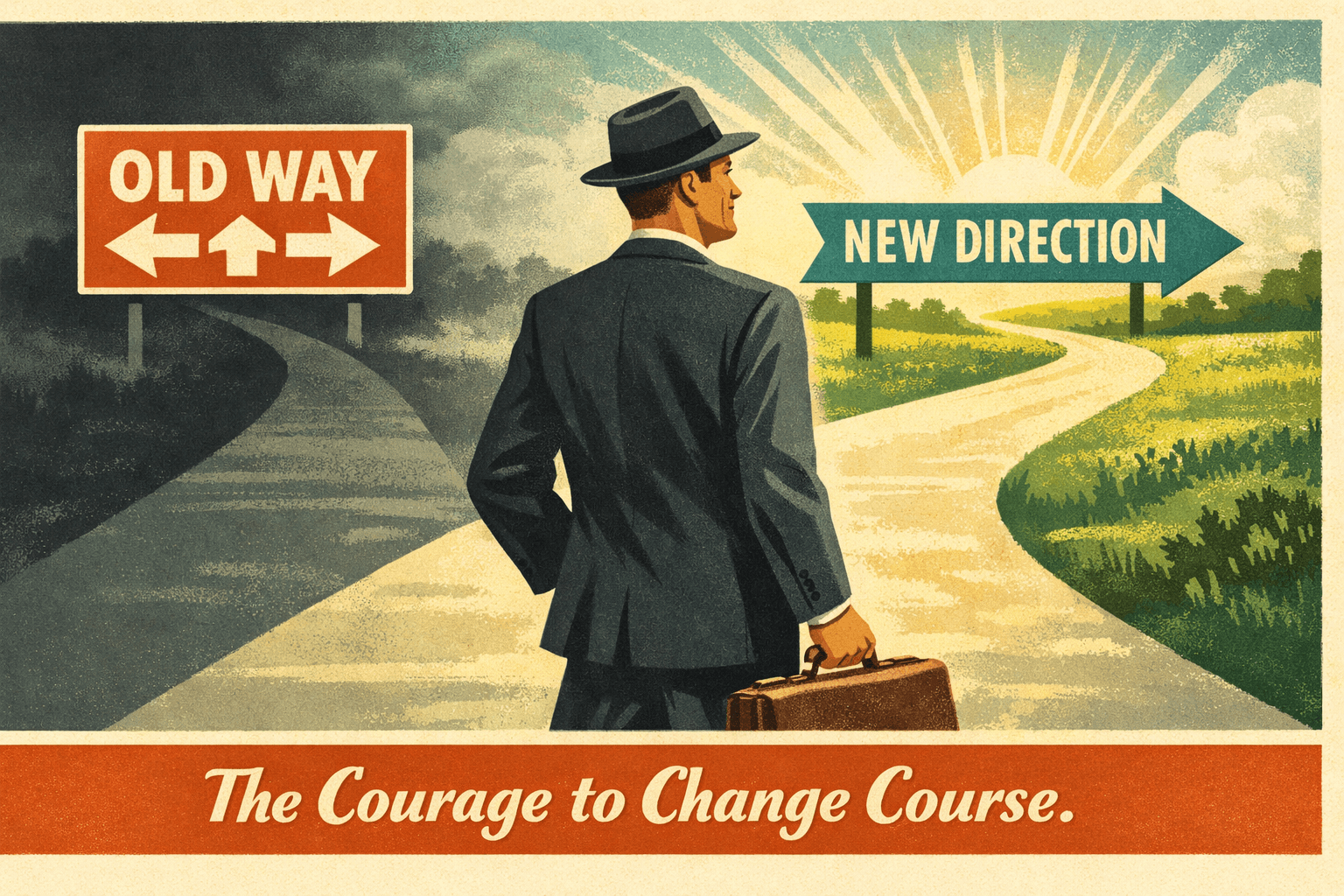
Think about it this way: if you're driving from New York to Los Angeles and you realize you're heading toward Miami, persistence doesn't mean driving faster toward Miami. It means having the courage to turn around.
But ego makes that turn nearly impossible. Because turning around means admitting you've been going the wrong direction. It means all those miles you drove were wasted. It means the confidence you had in your navigation was misplaced.
So instead of turning around, most people just drive faster. They convince themselves that Miami is actually pretty close to Los Angeles if you squint at the map right. They tell themselves that the journey matters more than the destination anyway. They find a thousand reasons why continuing in the wrong direction is actually the smart play.
This is the persistence trap: when commitment to your approach becomes stronger than commitment to your outcome.
The fighter keeps using the signature move not because it's working, but because abandoning it feels like admitting failure. The entrepreneur keeps pursuing a failing strategy not because it's producing results, but because pivoting feels like quitting. The employee keeps doing things the hard way not because it's effective, but because changing feels like weakness.
They've all confused their identity with their methodology. And ego will burn everything down before it admits the methodology is broken.
When Ego Disguises Itself as Determination
Here's how ego operates: it wraps itself in the language of virtue to avoid the pain of truth.
"I'm not being stubborn, I'm being persistent." "I'm not refusing to change, I'm staying committed to my vision." "I'm not ignoring reality, I'm maintaining faith in my approach."
These sound like strength. They feel like determination. But underneath, they're often just ego protecting itself from the uncomfortable truth that your current approach isn't working.
The mechanism is subtle but predictable. When you invest time, money, energy, and identity into a particular approach, admitting it's not working creates what psychologists call cognitive dissonance. Your ego hates this feeling. So it finds ways to reconcile the contradiction without admitting error.
It redefines success. "Sure, we're not profitable yet, but we're building brand awareness." It moves the goalposts. "The original timeline was unrealistic anyway." It blames external factors. "The market isn't ready." "The competition is playing dirty." "People just don't understand."
Anything to avoid the simple, brutal truth: the approach isn't working, and continuing it is insane.
But here's what makes this particularly dangerous. The more you've invested in a failing approach, the harder it becomes to abandon it. Economists call this the sunk cost fallacy. Ego calls it "staying true to yourself."
Each failed attempt doesn't make you more likely to change course. It makes you more likely to double down. Because now you're not just defending the approach. You're defending every previous decision to stick with it.
The fighter who's lost three fights using the signature move can't admit it's broken without admitting those three losses were preventable. The entrepreneur who's burned through two years and all their savings can't pivot without admitting those two years were wasted. The executive who's been championing a failing strategy can't reverse course without admitting they were wrong all along.
So they don't. They just fight harder, burn longer, champion louder. They call it persistence when it's really just ego avoiding accountability.
Strategic Surrender in Practice
But here's what changes everything: some people figure out how to separate their identity from their approach. They discover that surrendering a broken methodology isn't the same as surrendering themselves.
And some never figure it out. They let ego destroy everything rather than admit their approach is broken.
Consider Kodak.
In 1975, a Kodak engineer named Steve Sasson invented the first digital camera. The company had the technology, the talent, the market dominance, and the resources to own the digital revolution before it even began.
But there was a problem. Digital photography threatened film sales. And Kodak wasn't just a company that sold film. Kodak was film. Their entire identity, their century of success, their understanding of who they were in the world centered on being the film company.
Sasson's invention was shelved. Management instructed him to keep quiet about it. Not because the technology was bad, but because it threatened their core business model.
For the next thirty years, Kodak watched the market shift. They saw digital cameras gain traction. They witnessed consumers abandon film. They observed competitors building businesses around the technology they had invented first.
And still, they couldn't let go.
They made half-hearted attempts at digital. They acquired digital companies. They invested in digital technologies. But they never fully surrendered their film business because that would mean surrendering their identity. It would mean admitting that what made them successful for a century was now what was killing them.
Every decision was filtered through the lens of protecting film revenue. Every strategy was designed to delay the inevitable rather than embrace the future. They kept trying to make their signature move work in a sport that had fundamentally changed.
In 2012, Kodak filed for bankruptcy.
They didn't fail because they lacked technology or talent or resources. They failed because their institutional ego wouldn't let them practice strategic surrender. They couldn't separate their identity from their methodology. They couldn't tell the difference between abandoning film and abandoning themselves.
So they chose to die as a film company rather than live as something else.
This is what happens when ego wins. Not just failure, but completely preventable failure. The kind where you had every advantage and squandered all of them protecting an approach that was already dead.
Strategic surrender isn't about becoming less. It's about becoming more by subtracting what's holding you back. Kodak could have become the dominant digital photography company. They had a thirty-year head start. But they chose their identity over their future.
The fighter who abandons their signature move and develops a complete game doesn't stop being a fighter. They become a better fighter. The entrepreneur who pivots away from their original idea doesn't stop being an entrepreneur. They become a smarter entrepreneur. The leader who reverses a failing strategy doesn't stop being a leader. They become a more effective leader.
But you have to do the ego work first. You have to separate who you are from what you do. Otherwise, you end up like Kodak, holding onto your identity while the world moves past you.
The Questions Ego Won't Let You Ask
"A failure is a man who has blundered, but is not able to cash in on the experience." ~Elbert Hubbard
Here's the thing about blunders: everyone makes them. The fighter's signature move stops working. The strategy that used to deliver results stops delivering. The approach that built your early success becomes the ceiling that limits your next level.
These aren't moral failures. They're just reality. Markets change. Competition adapts. What worked yesterday doesn't always work today.
But Hubbard identified the real dividing line. The actual failure isn't the blunder itself. It's the inability to cash in on the experience, to extract value from what didn't work, to learn from the approach that failed.
And what prevents people from cashing in? Ego. Because cashing in requires admitting the blunder happened in the first place.
If strategic surrender is so powerful, why don't more people do it? Because it requires asking questions that ego absolutely refuses to consider.
Try these on for size:
What am I protecting by staying with this approach?
Most people think they're protecting their goal or their vision. But often, they're just protecting their ego. They're protecting the story they've told themselves and others about who they are and what they're doing. They're protecting themselves from the discomfort of admitting they were wrong.
Am I committed to the outcome, or just committed to being right?
This is the killer question. Because if you're honest, you'll often discover that proving your approach works has become more important than actually achieving the outcome you set out to accomplish. You've shifted from playing to win to playing not to be wrong.
If a stranger looked at my situation, what would they see that I don't?
Outside perspective is valuable precisely because it lacks your ego investment. A stranger isn't defending the last two years of their life. They aren't protecting their identity. They aren't justifying previous decisions. They can see your situation clearly because they have nothing to protect.
What would I do differently if I had to start over today?
This question cuts through all the sunk cost nonsense. It forces you to evaluate your approach based on current reality, not past investment. If you wouldn't choose your current approach starting fresh today, why are you choosing it now?
These questions are the mechanism for cashing in on your blunders. They're how you extract value from what didn't work. They're how you transform a failed approach into valuable intelligence about what to do differently.
But they're extraordinarily difficult to answer honestly because ego distorts every response. It provides rationalizations. It finds exceptions. It reframes failures as learning experiences and dead ends as character-building detours.
The discipline isn't in asking the questions. The discipline is in not letting ego hijack the answers.
Strategic Surrender vs. Complete Defeat
Here's the ultimate distinction, the one that separates strategic surrender from just quitting when things get hard:
Strategic surrender releases the approach while strengthening commitment to the goal. Complete defeat releases both.
Kodak could have surrendered film while remaining committed to capturing and preserving memories. They could have released their signature move while staying in the fight. Instead, they held onto film so tightly that they lost everything.
The fighter who develops new techniques hasn't quit fighting. They've quit being limited by one technique. The entrepreneur who pivots hasn't abandoned their business. They've abandoned one path to find a better route to their destination.
But this only works if you've done the ego work required to separate your identity from your methodology. If you can't tell the difference between "this approach isn't working" and "I am a failure," then any change feels like defeat.
That's why Sun Tzu's wisdom about knowing yourself is so critical. You can't practice strategic surrender if you don't know what you're actually trying to accomplish versus what you're trying to prove. You can't let go of broken approaches if those approaches have become your identity.
The path forward requires brutal self-honesty about what you're actually protecting. Are you protecting your goal, or are you protecting your ego?
The Discipline of Intelligent Surrender
Real strength isn't refusing to change course. Real strength is knowing when to change, having the courage to admit your current approach isn't working, and possessing the discipline to try something different even when it means eating humble pie.
This requires developing what might be called "intelligent surrender," the ability to recognize when persistence has crossed over into stupidity, when determination has become delusion, when commitment has calcified into ego protection.
How do you develop this ability? Start by separating your identity from your methods. You are not your approach. You are not your signature move. You are not your business strategy or your management style or your way of doing things.
You are the person pursuing a goal. The methods are just tools. And when a tool stops working, you get a different tool. You don't keep hammering with a broken hammer and call it persistence.
Next, build the habit of regular reality checks. Set predetermined milestones where you honestly evaluate whether your approach is producing results. Not whether you're learning, not whether you're growing, not whether you're building character. Whether you're achieving the actual outcomes you set out to accomplish.
If you're not hitting those milestones, you have three choices: change your approach, change your timeline, or change your goal. The only choice you don't have is to keep doing the same thing and expect different results while calling it persistence.
Finally, cultivate outside perspective. Find people who will tell you the truth, especially when the truth is uncomfortable. People who aren't invested in protecting your ego, who don't benefit from you continuing down a failing path, who care enough about your success to risk making you uncomfortable.
These people are rare and valuable precisely because they can see what your ego won't let you see. They can ask the questions you won't ask yourself. They can point out that you're driving toward Miami when you meant to go to Los Angeles.
Knowing When to Pivot
The trickiest part of strategic surrender is knowing when to do it. Pivot too early, and you quit before your approach has time to work. Pivot too late, and you've wasted resources that could have been deployed more effectively.
There's no perfect formula, but there are indicators:
If you're consistently hitting obstacles that require fundamentally changing your approach to overcome, you're probably fighting the wrong battle. If every solution requires ignoring reality or convincing everyone else they're wrong, you're probably attached to a broken methodology.
If you find yourself constantly explaining why results don't matter or why metrics are misleading, your ego is probably protecting a failing approach. If the gap between your expectations and reality keeps widening despite maximum effort, you're probably persisting in the wrong direction.
And here's the ultimate test: if starting fresh today, would you choose your current approach? If the honest answer is no, you've already stayed too long.
Strategic surrender isn't about giving up easily. It's about giving up intelligently. It's about having enough self-knowledge to recognize when you're protecting your ego instead of pursuing your goal. It's about possessing the strength to admit you were wrong and the courage to try something different.
Sun Tzu knew this 2,500 years ago. The battles you need to win aren't all external. The most important battle is the one against your own ego, against your resistance to change, against your need to be right more than your need to be effective.
Know yourself. Know when your persistence is actually serving your goals versus when it's just protecting your pride. Know the difference between strategic surrender and complete defeat.
Because the strongest thing you can do isn't refusing to change course. It's having the wisdom to know when changing course is the only way forward.
Your signature move made you who you are. But it doesn't have to define who you become.