Add a Zero
Most budgets are not too small. They are aimed at something nobody has actually seen yet, including the person paying for it.

I had a client last year whose budget was half what the venue needed. I could see it the moment I walked in. Instead of arguing over the number, I sent over mockups: their loudspeakers dropped into real photos of their own space, so they could see the finished aesthetic before a single wire got pulled. Within a week, the budget had doubled.
Nobody talked them into that. They saw what was possible, and the number caught up to the vision.
The planning fallacy in the boardroom
People do not fund what they cannot see. They fund what has already become real to them, and until a vision is real, no number attached to it feels true, not to the person signing the check and not to the committee arguing about it down the hall.
Daniel Kahneman named this the planning fallacy: the habit of forecasting a project by looking inward, at the plan itself, rather than outward, at how projects like it have actually turned out. A board guessing at a sound system budget is doing exactly that. They are pricing an idea in their head, not the venue in front of them, and the gap between those two numbers is rarely a negotiating tactic. It is the distance between an idea and its outside view.
That is why I stopped arguing with the number a long time ago. Arguing treats the budget as the problem. The budget is a symptom. The actual problem is that nobody has seen the thing yet.
What seventeen opinions have in common
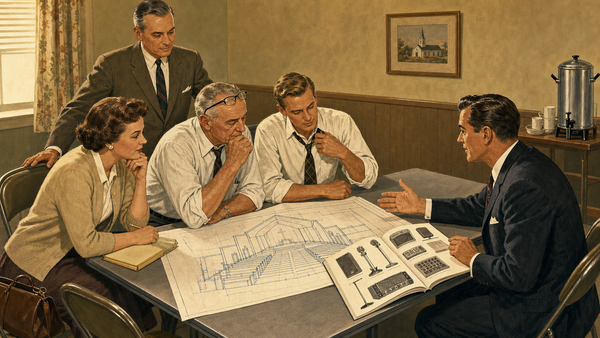
A lot of our projects put more than one decision maker at the table: a vestry, a building committee, a leadership team. I have sat across from committees seventeen people deep, every one of them with an opinion about carpet color and speaker placement. Left alone, personal taste will argue for weeks and settle nothing, because taste has no shared reference point. One person is picturing what they grew up with. Another is picturing what impressed them somewhere else entirely. They are not disagreeing about the room. They are disagreeing about seventeen different ideas that only exist in seventeen different heads.
The fastest way I have found to end that argument is not a vote. It is a shared picture. I ask what everyone loves about their current setup, what frustrates them, what breaks down day to day rather than during a big event, and what guests or staff complain about when nobody official is listening. Those questions sound like small talk. They are not. They are how that many private, competing visions get pulled into one visible, shared one.
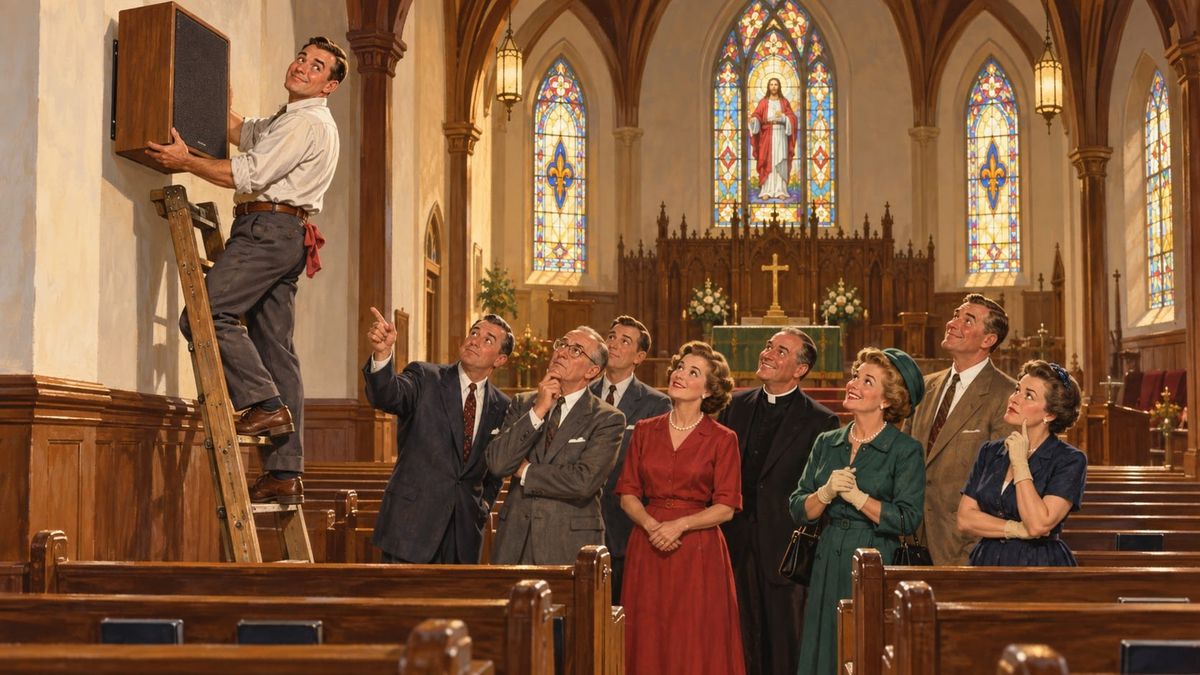
Sometimes the picture is not a rendering at all. On one project, we brought a demo loudspeaker on site, climbed a ladder, and held it up exactly where it would hang once the work was finished. The vestry did not need another meeting after that. Seventeen different ideas in seventeen different heads became one thing everyone could actually see, and the deal was done before we came down the ladder.
The room you cannot see
Frank Lloyd Wright liked to say that the reality of a room is not its walls but the space they create, an idea he borrowed from a much older one: a vessel is useful not for the clay it is made of, but for the emptiness inside it. I think about that every time I walk into a new project. A boardroom, a sanctuary, a cigar lounge, a living room, the walls are just the container. What the room is going to make someone feel is the actual thing being built, and it is invisible right up until it isn't.
That is the belief behind everything else in this piece. Every space I walk into is sacred, not because of what it was built for, but because of what it can make someone feel. The first work is figuring out what a room is supposed to make possible for the people who will stand in it, long before anyone talks about acoustics, lighting, or a spec sheet. The technical decisions are just the method for turning an invisible feeling into a visible, buildable thing.
Showing the thing itself
Once a shared picture starts to take shape, the work becomes proving it rather than describing it. We walk the site itself: acoustics, sightlines, how it gets used on an ordinary day against its biggest night, translating the feeling everyone described into something we can actually design against. None of it gets decided from a spreadsheet. It gets decided standing there, listening to the site the way we already listened to the people who use it.
The same instinct built those loudspeaker mockups, and the demo speaker on the ladder. It is why, once a proposal is approved, we get the decision makers on a call with our vendors directly rather than hand them a spec sheet and ask them to trust it. Every one of these moments does the same job: turning an invisible feeling into something a person can actually see, before they are asked to pay for it.
That is also where the real number shows up, and it is usually bigger than the one someone walked in with. I find myself saying the same thing to clients more often than I would like: add a zero. That is not a sales tactic. It is what happens once someone can finally see, clearly, what it takes to build the thing they wanted the whole time. The client with half the budget did not double his number because I convinced him of anything. He doubled it because he could finally see what he was actually asking for.
The vision I will not shrink to fit
That gap between the real need and the real budget is not always solved by asking for more money outright. Many clients do not know that lease to own arrangements exist, or that grants are available for religious and educational venues. We have access to both, and closing the gap that way is often part of the conversation before anyone talks about cutting the vision down to fit.
It does not only run in one direction, either. Just as often, once the real need is visible, the number comes down, because the vision never required what a client assumed it did. And when a budget genuinely cannot support the full vision, even after financing has been explored, shrinking the vision to fit is still not the answer. More often, I suggest building toward the final result in phases, so what gets installed today is a real piece of the finished vision rather than a smaller, permanent stand in for it. Sometimes the honest answer is simpler than that: wait, and come back once the budget actually matches the idea. And sometimes, when none of those will work, I turn the job down. I would rather do any of the three than hand someone a diminished version of their own idea and call it finished. A shrunken vision still looks, on paper, like the thing they asked for. It never feels like it, and by then nobody is checking the paper.
I can afford that position because of how we get paid. We work on a service based fee model, so our advice does not change with how much gear ends up on the order. That is the only reason the questions in this piece are honest ones instead of a sales script wearing a clipboard.
Nobody funds a vision they have not seen, not a board, not a committee, not a client standing in front of an idea that still only exists in someone else's head. If your idea is still invisible to the person who has to pay for it, that is the actual problem, long before anyone argues about the price.
Show them the thing itself. The number will follow.