Accidental Shabbat
I moved to Nashville and became more observant than I ever was before. All it took was two entrees for $12 and absolutely nothing to kvetch about.

There's apparently a whole book about being an Old Jewish Man: The Old Jewish Men's Guide to Eating, Sleeping, and Futzing Around. Nobody told me there'd be a manual. Nobody warned me this transformation was coming.
I'm turning 47 soon. Apparently that's when it becomes official.
Turns out I've been following the playbook anyway, one Saturday takeout order at a time.
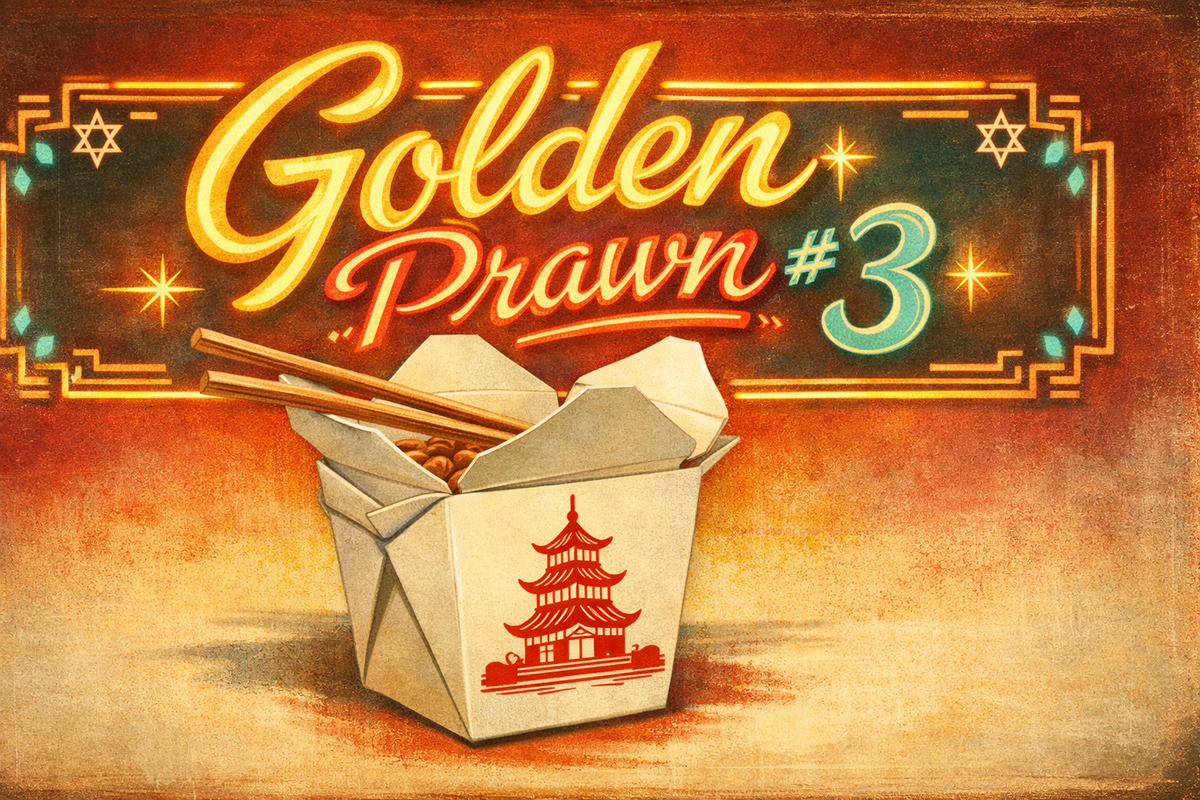
Golden Prawn #3 in Nashville. That's where I discovered I'm more religiously observant than I thought. Not through synagogue or study or any intentional spiritual practice. Through hot line Chinese food on Saturdays. Two entrees, $12, steam rising off the containers, staff so unfailingly pleasant I have nothing legitimate to complain about.
This last part bothers me more than it should.
According to the Official Old Jewish Men's Guide, I should be griping about something. The portions. The MSG. The parking situation (my only actual gripe). But they've systematically deprived me of my constitutional right to kvetch. The food's excellent. The price is absurd, and I mean that as the highest compliment an OJM can give. The staff are genuinely kind, not service-industry-fake-nice but actually warm.
I have no grounds for complaint. This is a crisis of identity.
But here's the kicker: I'm accidentally practicing Shabbat, and it took Chinese takeout to show me.
My mother grew up in Brooklyn. We didn't do the famous Jewish-Chinese food thing when I was young. No Christmas Day pilgrimages to Chinatown, no standing family tradition of moo shu pork and egg rolls while everyone else carved turkey. That cultural phenomenon, documented in films, books, scholarly articles, somehow skipped our household.
Yet here I am, a generation later, having moved to Nashville of all places, finding myself drawn there every Saturday. Not Sunday after church. Not Friday to kick off the weekend. Saturday. Shabbat. The day of rest.
I didn't plan this. I'm not observant in any traditional sense. But the pattern found me anyway.
Here's what I learned while writing this article: the historical Jewish-Chinese food tradition was about Christmas and Sundays, not Saturdays. Chinese restaurants were open on Sundays when other places closed for Christian Sabbath, so Jews made Sunday Chinese food their version of the post-church meal. My mom confirmed this. When she grew up in Brooklyn, Saturday Chinese food wasn't a thing.
But there's a newer pattern. Some contemporary Jews order Chinese for Shabbat dinner on Friday nights. I somehow split the difference and landed on Saturday lunch. Close enough to accidentally count as observant, far enough to prove I have no idea what I'm doing.
So I'm not inventing something new. I'm unconsciously participating in a pattern that goes back a century. Cultural DNA expressing itself without permission.
The Chinese food itself? Also largely fictional, which makes this whole thing even better.
Take General Tso's chicken, probably the most iconic Chinese-American dish. Completely invented. The dish is attributed to chef Peng Chang-kuei who created it in Taiwan in the 1950s, but it didn't become the sweet, deep-fried version Americans worship until it was adapted for New York palates in the 1970s. There was a real General Tso, Zuo Zongtang, a 19th-century Qing dynasty military leader, but he had absolutely nothing to do with chicken. The connection is pure marketing. Slap a prestigious-sounding name on fried chicken in orange sauce, call it a day.
So we have a fake general presiding over fake Chinese food that became authentically important to Jewish-American culture. The whole edifice is performance. And somehow that makes it more real, not less.
There's a joke that goes around: the Jewish calendar started 1,063 years before the Chinese calendar, meaning Jews survived all that time without Chinese food. They call it "the Dark Ages." Once we found it, there was no going back.
Golden Prawn #3 understands this perfectly. The "#3" isn't because they're the third location of a chain. It's branding, a knowing wink to the classic "China King #2" naming convention that Chinese-American takeout places have used forever. They're performing the genre right down to the name. They know you know what this kind of restaurant is, so they're leaning all the way into it.
It's knowing. It's self-aware. And it works because they execute flawlessly on the fundamentals.
The hot line setup is simple: high volume, fast turnover, steam tables keeping food hot and ready. No pretense, no table service overhead. Point at what you want, they load you up. Two entrees for $12 means I can go every Saturday without thinking twice. It's not a treat. It's just eating. That sustainability turns transaction into ritual.
And the staff being genuinely pleasant? That's the tell. Most places operating at this volume and price point are grinding through transactions. Staff burned out, barely making eye contact, surviving the shift. If the crew are consistently warm, it means management isn't squeezing them to death, the operation runs smoothly enough they're not constantly stressed, and there's probably decent culture there. You can feel when a business treats its people right, even in a 90-second interaction at a steam table.
So here I am. Old Jewish Man in Nashville, finding my Saturday ritual at a restaurant that's performing "classic Chinese takeout joint" as its entire concept, eating food that's as authentically Chinese as General Tso was a culinary innovator, participating in a tradition my Brooklyn-raised mother never practiced, and somehow through all this fictional layering finding something genuinely real.
I've always believed the silence between the notes is where the music actually lives. Maybe the same is true for tradition. The gaps, the adaptations, the things that are made up but become true through repetition and care: maybe that's where culture actually happens.
On New Year's Day, I opened my fortune cookie there. The slip of paper read: "Too tired for fortune today. Please try again later."
Even the fortune cookies know this whole thing is performance. But I'll be back next Saturday anyway.